


Field Guides
Paducah, Texas
(Cottle COUNTY)
Flatland horizons, strong hands, and true Texas grit in every mile.
Highlights
“In the middle of nowhere, but the heart of everything” is the local saying. Focusing on the “middle of nowhere” phrase is easy, but there is truth to the second half. In Paducah, you can stand at the intersection of U.S. Highway 70 and U.S. Highway 83. Drive west on Highway 70 and you will find the Pacific Ocean in Los Angeles; drive east and you can dip your toes in the Atlantic in Atlantic, North Carolina. Alternatively, if you choose Highway 83, driving north will take you to Westhope, North Dakota, on the Canadian border; heading south will put you at the Veterans International Bridge in Brownsville, on the Mexican border. Directions are easy–”just stay on this road…” Thus, the official town motto is The Crossroads of America.
For those less interested in road geography, the Matador Wildlife Management Area is eight miles from Paducah. It offers a trip back in time that allows for fishing, hunting, camping, hiking, and horseback riding in the vein of generations of cowboys. Surprisingly, the Matador Wildlife area is biodiverse, featuring a diverse array of species, including horned lizards, mountain lions, and pronghorns. Hunting is by permit and is the biggest (only?) tourist draw.
While the tourism industry outside of hunting is small, once you are in Paducah, you will appreciate the Plains hospitality, cleanliness, and evident work ethic.
The County Courthouse
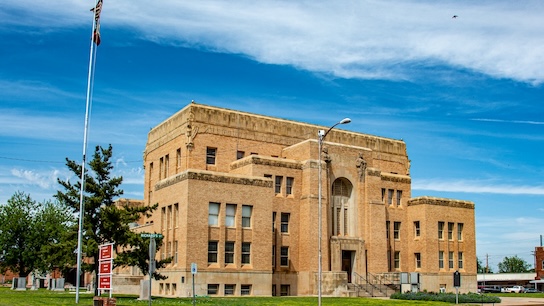
The Cottle County Courthouse is a magnificent “Moderne” design, built in 1929. Three versions preceded it– a room in someone’s home when the county started, a small frame structure built in 1892, and a two-story brick building with a bell tower completed in 1894. At the turn of the century, the trails between ranches throughout the Panhandle’s base and north central Texas passed through Paducah, leading to some prosperity. That leads to a bigger courthouse, financed by $150,000.00 in bonds.
The contract was awarded to the Wichita Falls firm of Voelcker & Dixon, which built 11 courthouses and numerous other buildings. This one should be page one of their portfolio. First, the building’s size is imposing. Four stories is large for a county with fewer than two thousand residents, but it gives the sense of importance and stability that Texas Ten believes essential for courthouses. Second, the terra cotta sandstone exterior fits the area like a glove and emits a pleasant, warm glow when there is a spectacular Texas sunset. Third, the Art Deco touches are subdued and integrated into clean lines and symmetrical elevations.
The main courtroom is beautiful and beautifully preserved. Most of all, we thought the motto over the entrance is one of the best statements about the importance of equal protection under the law we have seen: “To No One Will We Sell, Deny Or Delay Justice.” It’s a movie set.
Things To See And Do
The 28,000-acre Matador Wildlife Management Area is a premier hunting destination. Quail, pheasant, deer, hog, and turkey are all abundant. This type of public hunting comes with rules and regulations that are not imposed on hunters on private land. First Shot Outfitters from Coleman will guide a hunt in Cottle County. You can check for leases here.
There is an authentic ghost town, formerly known as Valley View, Texas, located four miles southwest of Paducah, and not to be confused with the current Valley View in Cooke County. Great for photographers.
Apart from that, get out of the car and tour the historic old town. There are several great buildings, including a M.E. Moses five-and-dime, an old drug store, and a special theater sign.
Food, Drinks, And Music (Eat Local!)
With a population that ranks 242nd out of 254 counties, the local food options are limited. The good news is that the chain competition is also low. Two of them are lovely, home-cooking Texas cafes: Crossroads Cafe and Whitaker’s Family Restaurant. The third is the throwback hamburger drive-in, Dixie Maid Drive-In, one of the best in the state. So good that it does not need social media.
Where To Drop A Dime (Shop Local!)
Shopping for more than the basics will require a drive to another county. There are antiques and flea market items at Stuff’s Gotta Go, and a combo salon/boutique with quality women’s apparel and accessories at Get Dun Up.
Special Places To Lay Your Head (Stay Local!)
No one is going to mistake the Hunters Lodge Motel for the Ritz, but we love the traditional feel and welcome hospitality. All you need for roughing it, but not too much weekends. Beyond that, you are looking for a short-term rental:
For The Professional Traveller (Campgrounds and RV Parks)
Special Events
Each April, Cottle County and King County combine to host the Old Settlers Reunion & Rodeo. Watching working cowboys strut their stuff is a good time.
Fore! (Golf Courses)
Paducah Country Club is a short nine-hole course with firm fairways, slower greens, and plenty of solitude unless it is Dove season.
Paducah Country Club
1300 E. FM 1038
Paducah, Texas 79248
(806) 492-2245
Getting to Cottle County
Cottle County sits at the base of the panhandle on the southeast side. U.S. Hwy 70, on an east-west axis, and U.S. Hwy 83 on a north-south axis, bisect Paducah. Depending on which road you take out of town, you can reach the Pacific Ocean, the Atlantic Ocean, the Canadian border, or the Mexican border, without turning off the road. Paducah is roughly equidistant from Wichita Falls to the east and Lubbock to the west, approximately an hour and 45 minutes from both. Abilene is two hours to the south. Amarillo is two hours and 15 minutes northwest.
The interstates are not close. I-40 is 90 miles north at the Shamrock exit, while I-27 is 90 miles west near Plainview. In the bigger picture, Paducah is three hours and 35 minutes northwest of the state’s geographic center in Bray, Texas.
For large carriers, Lubbock Preston Smith International Airport is your best option, as it handles American, United, and Southwest. Wichita Falls Regional Airport is American Airlines only. The city and county share ownership of Dan E Richards Municipal Airport in Paducah.
History
More than anything else, the origin story of Cottle County is buffalo. The giant animals once covered the plains, almost like an ocean covers its bottom, as many as 60 million in all. It made sense for Native Americans to focus their economy on something so abundant. Thus, the Comanche, Apache, Wichita, and other Plains tribes made their appearance in Cottle County for centuries. Until approximately 1700, the Lipan Apaches dominated; thereafter, the feared Comanche took control.
The Comanche threat ended in 1874 with Mackenzie’s victory at Palo Duro. Following the removal of the Comanche and other peoples, the buffalo hunters wiped the plains clean in a span of a few years. By the early 1880s, Cottle County was open to Anglo settlement, unlike anything it had been for the preceding thousands of years.
The legislature created the county and named it for Alamo defender George Cottle in 1876. There was no administration of the area, however, until 1892. In the interim 16 years, the population grew slowly. The 1880 census reported only 24 settlers, but by 1890, the number had increased to 240 souls. During the period, the county land was used for open grazing by large ranches. The state decided the county should be formally organized because a murder had occurred, and the citizens wanted a trial in the county.
Paducah was named the county seat, something that made Richard Potts happy. Potts, an early settler from Paducah, Kentucky, had secured substantial acreage in the area. He achieved the feat of naming his new hometown after his old hometown by trading acreage for votes. By the time Paducah became the county seat, it was linked to other large settlements in the area via roads. Through the end of the 19th century, however, cattle ranching was far and away the economic lifeblood of the county.
Cotton came to Cottle as the century turned, mainly because the construction of a gin in the county reduced transportation worries. In the three decades before the Great Depression, farming of cotton, wheat, sorghum, and other crops, and raising chicken and pork, replaced some of the county’s dependence on cattle. That diversification did little to protect against the twin devastations of the Dust Bowl and teh Great Depression. The eventual response to these calamities was to mechanize agriculture, making it more efficient. Cottle County successfully achieved this, returning farms and ranches to economic viability. The cost, however, was the loss of agricultural jobs. Cottle County’s population has been steadily decreasing for nearly 100 years.
Today, Cottle County remains a farm and ranch county, with a significant portion of its land devoted to cattle raising (approximately 60%) and another 35% divided among other livestock, cotton, wheat, and corn for feed. Almost everybody works, as the unemployment rate is abnormally low. Still, the median family income, average personal income, and poverty rates place Cottle County well behind Texas and national averages. Paducah falls slightly behind in the percentage of eligible residents with high school degrees and even further behind in post-secondary education. The county is comprised of 59% Caucasian, non-Hispanic residents; 26% Hispanic residents; 9% individuals of mixed race or ethnicity; and 5% African American residents. While Cottle County is currently deep red in terms of politics, voting 86% for President Trump in 2024, it was a conservative Democratic County from its inception until 1992.
The most famous person from Cotttle County was extraordinarily famous, although few knew his name. Clarence Hailey Long Jr. was a hard-working ranch hand. He was also “The Marlboro Man.”