


Field Guides
Crane, Texas
(Crane COUNTY)
Oil country skies, desert stars, and life powered by hard work.
Highlights
Oil. Oil is the highlight of Crane County, and its only city, Crane. Crane is located close to the geographic center of Texas’s fabled “Permian Basin,” one of the richest fossil fuel sources ever discovered and captured. Ector County (Odessa) and Midland County are immediately to the north. Those two cities hold the heart of West Texas oil; the headquarters are there, the millionaires and billionaires are there, and the crews are assigned from there.
Crane, just 25 miles south, is a field location. The work gets done in Crane. If you want to learn about the day-to-day workings of the oil industry, Crane would be the place to start. You can learn quite a bit about the oil industry, the geography that created the Permian Basin, and the history of teh area at The Museum of the Desert Southwest. Admission is donation-based, and it is open on Tuesday from 10:00 am to noon & 1:00 pm to 3:00 pm, and on Wednesday from 10:00 am to noon.
We prize honesty at Texas Ten, so we are not pretending that there is any other reason to visit Crane other than the oil business, friends and family, fill up the truck, or grab a quick bite. But whenever and wherever you do fill up the truck, thank the people of Crane.
The County Courthouse
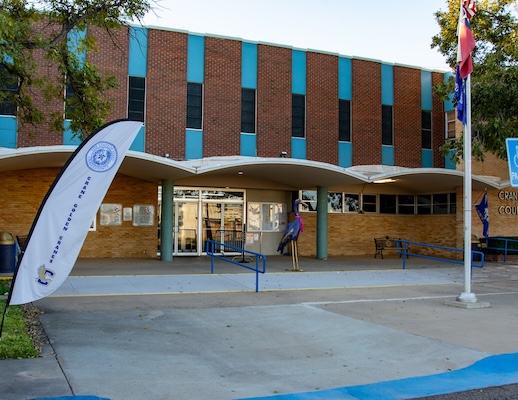
Crane is a rarity in the Texas courthouse world, having had only two structures serve as courthouses. The first was a two-story adobe structure built in 1927, the year the County was organized.
The current one-story edition was built in 1947 and remodeled in 1958. The 1947 construction project also included the hospital and nursing home. The building is simple, with clean lines and brick construction. The most notable feature is the entrance, which features a modern cover with a wavelike design, reminiscent of a South Florida Art Deco entrance. It is a nice touch.
Things To See And Do
In addition to the Museum of the Desert Southwest, if you are into historical markers, one of the best in the state is south of Crane on U.S. Hwy 385. The marker draws your attention to Horsehead Crossing, a truly historical point along the Pecos River. Given that the area was essentially uninhabited until the early 20th century, the number of important 19th-century figures and events that passed through this point is astounding.
Food, Drinks, And Music (Eat Local!)
People work hard, long hours in Crane. Thus, despite its remoteness and smaller population, there are several choices for quality eats. We will start with a local favorite, and a great place to get full and feel a little nostalgic at the same time, Howard’s Drive Inn. Awesome burgers. JuJu’s Food Company is a food truck that also gets rave burger reviews. We do not usually include trucks, but this one has a permanent location, outdoor seating, and may have a brick-and-mortar location soon.
Las Patronas is a recently remodeled and enlarged Tex-Mex hangout. Grandma’s Cafe (no social media) has fans who swear by their burritos, while Rudy’s Restaurant and El Rey Sol Mexican Restaurant are also great Tex-Mex options. Frost Bites is loved for its desserts and frozen treats, but also has quality home-cooking meals.
Satisfy your pizza craving at Hero’s Pizza. Mario’s Japanese Steak House and Sushi Bar seems unlikely (at least the sushi part), but it is well thought of. Finally, a great time will be had by all at The Bird Beer Hall, featuring cold beer and a sports bar menu.
Where To Drop A Dime (Shop Local!)
Odessa and Midland are quick drives, particularly given that the speed limit is a vague suggestion around here.
Special Places To Lay Your Head (Stay Local!)
There is a clean, basic hotel in town. Otherwise, it is probably Odessa or Midland.
For The Professional Traveller (Campgrounds and RV Parks)
Keep in mind that your neighbors will likely be here for work rather than relaxation.
Derrick Trailer Court & RV Park
Special Events
The Crane County Arena hosts the Sandhills Rodeo each May.
Fore! (Golf Courses)
A short nine-hole course that can be difficult when the wind is up, which is often. Small greens place a premium on your short game. It is a “country club” in the sense that membership is available, but all are welcome.
Crane Country Club
230 Golf Course Rd.
Crane, Texas 79731
(432) 558-2651
Getting to Crane County
Crane is 30 miles directly south of Odessa, about in the center of West Texas. U.S. Highway 385 is the main street into and through town, connecting to I-20 at Odessa. I-10 passes about 30 miles to the south as the crow flies, but navigating to Crane from I-10 is not a direct shot. Exit at U.S. 385 near Fort Stockton if you are eastbound; the road takes you through McCamey, then veers sharply westward into Crane. If traveling eastbound on I-10, exit at Sheffield, then take State Hwy 3349 north through Iraan. Continue on U.S. Hwy 67 to U.S. Hwy 385, and then head north. Crane is three hours and 10 minutes of drive time slightly northwest of the state’s Geographic center in Brady, Texas.
Flying in on a major carrier is possible if you drive from the Midland International Air & Space Port, which handles American Airlines, Delta, Southwest, and United. The drive from the airport to Crane is about 50 minutes. Small craft can use Crane County Airport-E13. If you need a little more room, Odessa-Schlemeyer Field Airport and Fort Stockton-Pecos County Airport are conveniently located nearby.
History
The critical history here spans hundreds of millions of years. Somewhere around a billion (with a “B”), tectonic shifting created the bottom of the basin. Like most of Texas, the basin then spent hundreds of millions of years submerged under the ocean. The remains of these creatures became today’s fossil fuel through the immense pressure exerted on them by the sediment that remained after the oceans receded.
Early in the machine age, no one gave much thought to the oil in the Permian Basin. Early wells were of limited success, as the oil found was challenging to bring to the surface. That all changed on May 27, 1923, in nearby Upton County when “Santa Rita No.1” came in. There was oil in West Texas, and it came blasting out of the ground. Over a hundred years later, the Permian Basin provides 40% of the nation’s oil production and 20% of the nation’s methane gas production.
Oil boomtowns popped up all over West Texas. Crane was one of them. The legislature formed Crane County in 1887, but it was almost empty of permanent residents. Supposedly, the census reporter for 1890 met with all 15 residents for coffee so he could gather the necessary information quickly. Not much had changed by 1920, when the census reported 31 residents for the county.
Those numbers belied an important historical fact: many famous Texans and even more cattle had passed through Crane County. Horsehead Crossing stands as witness to that. The Pecos River cut through West Texas as a formidable obstacle to moving anything from one side to another. The river could be forded at this location in Crane County, so travelers made use of it.
The first were probably Comanche returning from Mexico and needing water for their horses. Next came Dr. Henry Connelly, in 1839, who attempted to establish a more effective trade route between Mexico and the United States. Ten years later, famed Texas Ranger Rip Ford and equally famed Indian Agent Robert Neighbors crossed during their hunt for a wagon route to El Paso. Close on their heels were the U.S. Army cartographers, searching for a good route to California.
Not long after, the area became a stop on a mail route pioneered by Henry Skillman, maybe the world’s greatest mailman. He developed the route and served as its contractor for most of the early 1850s. When the postal commissioner demanded passenger service on the route, the economics did not work for Skillman, and he bowed out as the primary carrier. He continued to substitute for the new contractor. In that capacity, he recorded the first mail delivery from San Antonio to San Diego. In 1858, the first mail route from the Midwest’s great cities to the West’s great cities was established through the Butterfield Stage. Skillman took the reins of that first stage at Horsehead Crossing and arrived in El Paso 96 hours later, with no help.
After the Civil War, the next decade saw great cattle drives crossing at Horsehead. Charles Pyron, John Chisum, and Charles Goodnight/Oliver Loving, a veritable who’s who among cattlemen, all made the crossing. Goodnight lost enough cattle in the Pecos to deem it “the graveyard of a cattleman’s hopes.” Which brings us to the rather gruesome reason for the name of the crossing. The skulls of deceased horses littered the crossing, most of whom died not in the river, but because of it. Either the brine of the water or overconsumption after days in the desert caused their deaths. Whatever the reason, the establishment of rail routes consigned stories like these to the history books, as the crossing was no longer a necessary evil.
By 1927, Crane’s importance was again evident as all types of get-rich-quick schemers descended on the small town. The county finally formally organized, and Crane, its only town, became the county seat. Both the county and town are named after William Carey Crane, who served as president of Baylor University from 1864 to 1885, before its relocation from Independence to Waco. Crane was a prominent Baptist with friends all over the state, but any connection to the county that now bears his name is unknown and unlikely.
Oil took over and never lost its grip. Billions of barrels have been pumped out of the ground in Crane County. It remains in the top 10% of Texas counties for oil production to this day. As exploration gave way to pumping, however, the population plateaued at its current level of around 4,500. Today, the population is primarily involved in oil field work or the businesses that support it.
The County’s racial/ethnic demographics are surprising, with 68% of the population listed as Hispanic; 26% non-Hispanic Caucasian; 2% African American; 2% Asian; and 2% mixed or other races. The median family income is only about 80% of the Texas average and 75% of the US average, but the number of people living at or below the poverty line is lower than the Texas and national figures. Educational attainment is slightly behind for high school graduation and significantly behind for post-secondary degrees. In politics, Crane was a consistently Democratic County until 1968 when its citizens cast a plurality of ballots for George Wallace. From 1972 forward, the GOP has carried Crane County every time, usually by healthy margins.
Famous people from Crane include Gary Gaines, the real-life coach of Odessa Permian High School, profiled in Buzz Bissinger’s book Friday Night Lights, and Kenneth Walker, one of only five deaf persons to have played in the N.F.L.