


Field Guides
Gainesville, Texas
(Cooke COUNTY)
Small-town charm, rolling hills, and friendly faces at every turn.
Highlights
Gainesville, the county seat of Cooke County, may be the most surprising small town in Texas. Smallish, rather than small, actually – the population is over 17,000. Many Texans know it as the last stop on the way to Oklahoma’s version of Sin City, Thackerville. There sits the WinStar World Casino, just 11 miles north of Gainesville and surrounded on three sides by Texas. Many Texans have passed through Gainesville on I-35, headed north full of hope and headed south full of wisdom. Hopefully, they caught a good concert.
The point is that travelers would do well for themselves and their pocketbook if they spent more time exploring Gainesville and its neighbors, Muenster and Valley View. Even better is the fabulous scenery offered through Lake Texoma, Lake Ray Roberts, Lake Kiowa, the Red River, and the unspoiled horse country in the area. Gainesville houses one of our favorite small museums, the Morton Museum of Cooke County. Of particular interest is the exhibit on the Community Circus through which Gainesville once earned the title “Circus Town, USA.”
The County Courthouse
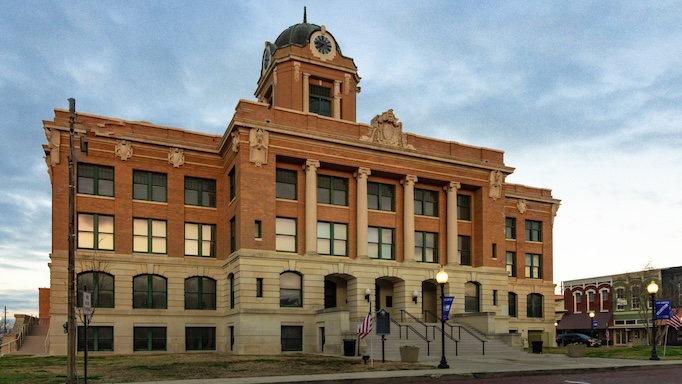
The current version is Cooke County’s fourth courthouse. The first was a temporary log cabin, the second a one-story frame building that burned in 1880, and the third a two-story limestone structure that lasted from 1880 until it burned in 1909. High winds are a fact of life in North Central Texas, which may account for Cooke County exceeding its quota of one burned courthouse. While there were two fires, the collapse of the first courthouse may have been the most spectacular, according to local legend, which claims that a stray steer knocked it over.
In any event, this one is built to last. In recognition, the locals refer to it as “the Grand Old Lady.” The renowned Lang & Witchell Dallas architecture firm designed the building. It was unique in scale–the cornerstone weighs 3,000 pounds. More daring was the combination of Beaux Arts and Prairie Style elements in one building. The result is pleasantly unified and impressive. Seventy feet to the roof, topped with a copper dome, finial, and clock that suggests the Back to the Future courthouse scene, the Cooke County courthouse is an appropriate anchor for downtown. The county marked the 100th anniversary of the Grand Old Lady in 2011 with a rededication that also marked a comprehensive restoration to its original state.
The building, or more precisely, the grounds, is not without controversy. As in many places, the issue is a Confederate monument. The aggravating issue with this one is the inscription on its base, which can be read as exonerating the South of all wrongdoing. Always an emotional issue, we leave it for you to consider.
Things To See And Do
The dominant feature of Cooke County is the Red River that forms the northern border of the county and the state’s boundary line with Oklahoma. Four forks of smaller tributaries serve as the headwaters for the Red River. Cooke County is to the south and east of the junction of the Prairie Dog Fork and the North Fork. One thing every Texan should do is see the Red River; that is easy enough. We traveled a few miles north on I-35 from Gainesville before reaching the bridge that spans the river. There was off-road parking available.
The Red River is historic as a point of exploration and as a boundary — and not just between Texas and Oklahoma. It once separated the Spanish and French holdings in the New World. Later, it marked the countries of Texas and the United States on either side. Texas and Oklahoma fought over the boundary definition, both legally (at least twice, all the way to the Supreme Court) and with their militias.
Crossing the Red River was of great economic consequence. Many of the crossings had trading posts. The “Old Chisholm Trail” crossed at Preston, and the Shawnee Trail crossed near present-day Pottsboro, both to the east of Cooke County, but the “New” Chisholm Trail went through Gainesville. The Great Western Trail crossed to the west of Gainesville at Doan’s Crossing, near present-day Vernon. For several decades, Gainesville was at the center of a great American enterprise, immortalized to this day. It is nice to give it a tangible feel.
The Red River is important today for a different reason. In 1944, the Denison Dam created Lake Texoma, the 24th largest man-made lake in the country and the third largest lake with waters in Texas. Texoma occupies part of Cooke and Grayson counties, with the large majority in Grayson County (or in Oklahoma). For an in-depth look at Texoma, visit our Grayson County page.
That is not the end of the lake story. Lake Ray Roberts is at the corner of Cooke, Denton, and Grayson counties, with Cooke and Denton holding the lion’s share, so we describe it here. Roberts is a Corps of Engineers lake leased to the Texas Parks and Wildlife Department. The nice thing about Corps of Engineers’ lakes is that the entire shoreline remains open to public access; the Parks department takes advantage of this feature to operate Ray Roberts Lake State Park. The state park offers diverse areas, perfect for swimming (two sandy beaches are available), hiking, camping, fishing, boating, and public land hunting (including hog, dove, quail, and varmints). Roberts is a big lake – not Texoma big, but still very large, at nearly 30,000 surface acres – so the fishing is diverse, with the headliner being largemouth bass.
Another option is Lake Kiowa, a smaller private lake with a great golf course and a serene atmosphere – if you can get an invitation. Finally, the Red River is more than history and a feeder to Lake Texoma. There are exceptional blue catfish in the water. Unfortunately, they can be hard to get to. Sandbars make boat navigation difficult, and much of the river is private property; therefore, shore fishing spots are rare, although they are available near major roads. An airboat adventure, however, might solve those issues.
Hunting is an option for the avid outdoors person. Hog, turkey, and migratory birds (watefwol, dove, and quail) are the most likely prizes. Check out the Where to Drop a Dime section for guides and private hunts. Or a completely different type of hunt: Hill House Manor is one of the most haunted places in Texas. So a ghost hunt could be in order.
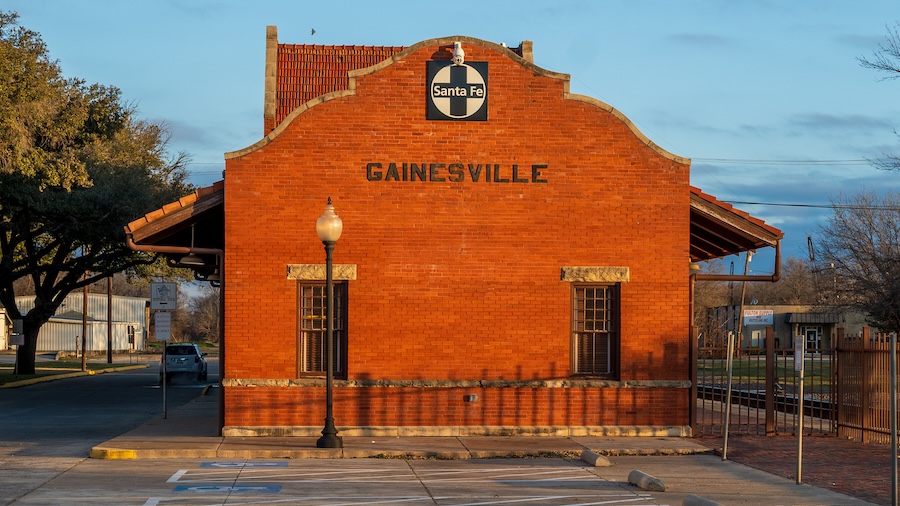
Gainesville is well worth a day trip to explore its thriving downtown boutique and restaurant scene. We loved several of the stores detailed in the shopping section, but Paige Davidson’s Studio deserves a special shout-out for both the artwork and the remodel. Paige was there to walk us through her story. Set aside time to tour the Santa Fe Depot and the Morton Museum of Cooke County. The depot showcases memorabilia from Gainesville’s community circus, which is something worth seeing. Both buildings are spectacular. The Frank Buck Zoo is a quality small zoo that children love.
Cooke County is at the center of a boom in North Texas wineries, making a tasting tour a great option. Deschain Cellars and Winery and Landon Winery are in Gainesville. Edge of the Lake Vineyard, Firelight Vineyards, and 5 Fifty-Five Vineyard & Winery call Valley View home. In Muenster, 4R Ranch Vineyards and Winery has the field to itself and specializes in gorgeous views. Back in Gainesville, Krootz Brewery Company offers an interesting selection of beers brewed on-site.
Finally, it should not surprise us, given that the area’s history goes back to “real cowboys.” This is horse country, and you can ride at a variety of places. The services offered vary, so to find what you are looking for, browse the following: Arrowheart Ranch, Camp Tonkawa (for kids), Circle D Ranch, Gainesville Riding Club, and Transform Equine (riding as a form of healing). Surrounding counties have many more.
Food, Drinks, And Music (Eat Local!)
Gainesville has a surprisingly diverse and advanced food scene, although the linen cloth, white glove experience is not here yet. You can drive to Dallas for that, if you must. Along that line, however, White Horse Steak House at Oak Meadow Ranch offers a private dining experience with an upper-crust chef. If you need the big night out, that would be our choice. It is in the country.
Let’s start downtown with a quartet of casual but upscale cafes/bistros focused on classic American dishes: 1860, the restaurant at the Overland Hotel, Sarah’s On the Square, the County Seat Kitchen and Cocktails, and Goodies on Commerce. For a more high-energy meal, but still within the traditional American sphere, consider Krootz Brewing Company or Main St. Pub & Steakhouse. For the traditional Texas diner experience, the Cornerstone Cafe does the “home-cooked, friendly atmosphere, fill you up” thing as well as anyone. Los Mariachis Mexican Restaurant fills the need for Tex-Mex downtown. The Hungry Hippo is a great sub shop and a long-time downtown favorite. The best pizza in town is at Saint Joe’s Pizza, with pasta and salads too. Just to the north of downtown, Jaz’s BBQ gets great reviews from the locals, but be prepared for a rustic atmosphere.
If you are in a hurry to get to WinStar, several restaurants are immediately off I-35. El Tapatio (on the northbound side) and Villa Grande Mexican Restaurant (on the southbound side) have Tex-Mex covered, whether you’re coming or going. North of the I-35 and US Highway 82 intersection, you can try La Patrona Taqueria. If classic family-style Italian is the question, Fera’s Italian Restaurant is the answer south of Highway 82 and Al’s Luigi’s Italian Restaurant is the answer to the north of Highway 82.
Just a little bit farther west of I-35 is Wolf Den Family Restaurant, a Texas gem of home cooking—one of Gainesville’s favorites.
For those looking to be close to Highway 82, traveling east and west, we start with two great down-home options. Trail’s Inn Restaurant, located on the east side of I-35, has served great comfort food for over forty years. On the west side of I-35, the Parker brothers have been doing great steak in a casual setting for more than five decades at the Traildust Steakhouse Saloon. Close by is Dieter Brothers, offering a wide variety with a special affinity for pit-smoked barbecue. There is also a two-in-one concept that covers all your down-home cooking desires at The Neu Ranch House and Catfish Louie’s.
Also along Highway 82, more Tex-Mex is at the original El Tapatio location, Restaurant Comida Mexican Castillo, Taqueria El Vaquero, and Mi Casa Mexicana Restaurant. For the more adventurous eaters, Indian Dhaba, Fuku Japanese Grill, and New Asian Buffet offer world cuisine options.
If you are on the Cooke County side of Ray Roberts, Valley View is the lake town to stop by. The Bluebonnet Cafe & Coffee Bar is our top recommendation, offering stellar comfort food and a full bar. Middlebrooks Bar has the best burger around. Tia’s Tex-Mex BBQ requires no further explanation. The 1845 Bar & Lounge is not an eatery but deserves mention for its atmosphere and craft cocktails.
In Muenster, Rico’s Place does Tex-Mex, while Rohmer’s Restaurant conquers home cooking. Kountry Korner handles the pizza category. Doc’s Sports Grill is an excellent place for burgers and atmosphere.
If you are in Lake Kiowa, the Lodge is the place for members and guests. Manuelito’s is a cozy and cherished Tex-Mex spot. For drinks and bar food, it is the 902 Bar and Grill.
Where To Drop A Dime (Shop Local!)
Gainesville boasts an active downtown shopping scene, featuring a diverse array of boutiques and stores with stories. It is all subjective, but our favorite was Paige Davidson Studio. Paige has to be the world’s foremost painter of Airstream trailer pictures, which hit a sweet spot for us for personal reasons. Her studio is a Gainesville treasure, a building over 125 years old, first built by Gainesville’s first mayor, later owned by Paige’s grandfather as an auto parts store, and lovingly restored by Paige. In addition to the studio space, Paige offers a tremendous handbag line through Cahoots Handbags. Vantage Point Art Gallery is another art stop, manned by local artists and well worth your time.
A girls’ weekend in Gainesville might put the pocketbook in real danger. Boutiques majoring in women’s apparel include Bella Bliss Boutique, Infinity Raine, Harper Jane Boutique, Bungalow 123 Boutique, The Twisted Hanger, Gypsy Star’s Darlings, and Pistols ‘n’ Petticoats. Although some of the following stores offer clothes, they also feature a wide variety of decor and gifts. Check it out at Brass Bunny, Uniques Gallery, Good Things Gainesville, The Ten Twenty-Five Collection, and Amelia’s Attic.
We enjoyed a stop at Kinne’s Jewelers, which has been in business for 136 years as of 2025. The store is a time capsule, as many of the display cases and decorations are over a century old. Wiese’s and Moss and Metal round out your jewelry shopping options. All of these stores are within easy walking distance of each other. Start on California Street and make the loop around downtown.
Muenster has a small shopping district on Main Street, between First and Second streets. Fresh Fellas, Main Street Mercantile, and the Bird’s Nest are quality antique stores, while Vintage Soul, Sister’s Gifts, and Girlfriends are for women’s wear. Gehrig’s Hardware is a fifth-generation business with a unique assortment of goods. A few blocks away is another antique store favored by those with a nose for quality vintage finds, Muenster Antique Mall. Two other stops worth making are Fischer’s Meat Market (98 years young) and Bayer’s Kolionalwaren for strudel and other traditional German pastries.
If you prefer the outdoors, you can shop for hunting and fishing experiences.
The Prairie’s End Hunt Club (Quail and Pheasant)
Miller Double A Ranch (Whitetail Deer and Exotics)
North Texas Duck Hunt Club (Waterfowl, based in Rockwall but with Red River properties)
Frontline Heroes Outdoors (Pheasant)
Ray Roberts Public Hunting Land (Various)
North Texas Guide Fishing Service (Catfish)
Texas Freshwater Adventures (Ray Roberts fishing)
Big Bite Guide Service (Ray Roberts fishing)
Guide Tim Wike (Ray Roberts fishing)
Ucatchem Guide Service (Ray Roberts and Texoma fishing)
Phil’s Guide Service (Ray Roberts fishing)
Clint’s Guide Service (Ray Roberts and Texoma)
Special Places To Lay Your Head (Stay Local!)
The new thing in Gainesville is an old thing. The renovated Overland Hotel brings a significant amount of high-end comfort to Gainesville. Beyond that, the charm is in retreats, wineries, bed and breakfasts, and short-term rentals. There are a lot of them. Here are some to check out, divided by area:
Gainesville
Lancaster Manor Bed and Breakfast
Muenster
Valley View
For The Professional Traveller (Campgrounds and RV Parks)
Special Events
In addition to traditional holidays, For the Love of Art in February is a tremendous fundraiser for, and an opportunity to appreciate, the finer things in life; July is Gainesville Rodeo Days; October sees Gainesville host Depot Days, which includes one of the better car shows in North Texas; November brings the Gainesville Wine & Country Festival. Muenster’s big party is Oktoberfest, the second weekend of October.
Fore! (Golf Courses)
Cooke County offers two 18-hole options, Gainesville Municipal Golf Course and Turtle Hill Golf Course in Muenster. The Gainesville course is reminiscent of links-style courses, but with smaller greens. Turtle Hill is a non-municipal public course that has garnered good reviews from The Dallas Morning News for its scenic nature. Both are good value propositions.
Gainesville Municipal Golf Course
2240 Weber Dr.
Gainesville, Texas 76240
(940) 668-4560
7708 N. FM 373
Muenster, TX 76252
(940) 759-4896
Getting to Cooke County
Fall just short of getting to Oklahoma. As already noted, Gainesville is about 11 miles short of the Texas/Oklahoma line on I-35. For another landmark, Gainesville is almost due north of Fort Worth. U.S. Highway 82 is the major east/west thoroughfare, running roughly parallel to the Red River. That places Gainesville four hours’ drive time northeast of the state’s geographic center in Brady, Texas.
If you want to fly in on a big plane, your likely landing spot is Dallas-Fort Worth International Airport, an hour to the south of Gainesville. DFW handles most carriers except Southwest. If you need a Southwest flight, Dallas Love Field will get it done, albeit at the cost of an extra twenty minutes of driving, possibly more, depending on Metroplex traffic. Gainesville Muni Airport is suitable for most smaller craft, but if you are in between sizes, any of the following airports are within an hour’s drive: Denton Enterprise Airport, Fort Worth Meacham International Airport, Perot Field Fort Worth Alliance Airport, or Addison Airport.
History
The area we know as Cooke County has always been a borderland. The first nations it separated were the Caddo and the Comanche. If the early European explorers traveled through the county, we have yet to find the tracks they left behind. The land was first deeded by the Mexican government in 1828 as part of the Cameron land grant, but no settlers took Cameron up on this particular offer.
Real settlement can be traced back to 1848, when the legislature created the county, named after Texas Revolutionary William G. Cooke. Side note–it was Cooke who saved Santa Anna’s skin after capture at the Battle of San Jacinto. He was in charge of prisoners when the Mexican scoundrel was found in enlisted clothes. Some of the boys wanted to “Remember the Alamo” a little more, but Cooke knew what Sam Houston wanted to see the Mexican Commander to finalize truce terms. So he intervened.
The first Cooke County boundaries included what is now Montague, Caly, Jack, and Wise counties. The legislature trimmed those areas away in 1857, when the county achieved its current shape. In the interim, important trails began to crisscross the county. Those included the Mormon Trail, a branch of the Chisholm Trail, and the Butterfield Overland Mail route. With enough traffic, the county organized a government and established a county seat in what is now Gainesville in 1850.
The Army had established Fort Fizhugh in 1847 as protection against Indian raids. The fort’s commander was apparently satisfied that the fort had been named for him, so he suggested his former commander, Edmund Pendleton Gaines, for the naming rights. Gaines was in charge of the US Army’s Southwest Division during the Texas Revolution. While constrained by the United States’ official neutrality stance, Gaines did what he could to protect the rebels.
Fort Fitzhugh was largely effective in providing cover from the Comanche and others. Settlers drifted in from southeast America, mainly from Tennessee, Missouri, and Arkansas. Most came without slaves, and the county was one of the few that voted against secession. The fact that the county was relatively evenly split between Union and Confederate sympathies portended one of Texas’s darkest episodes of mob violence.
In October 1862, citizens began rounding up other citizens. The suspicions were diverse–the apprehended might be aligned with Native Americans, the Union, or maybe they were just bandits. Whatever the motivations, 40 men died by the noose. Another two were shot dead trying to escape. At the time and for a long while afterwards, the carnage qualified as the country’s most deadly episode of mob violence. In the years since, Gainesville has worked hard to overcome the episode; its treatment of Medal of Honor winners and other outreach resulted in Gainesville earning the title of America’s Most Patriotic City in 2014.
The railroads arrived in the county in 1879. By 1887, the line traveling from Galveston to Chicago passed through the county. At about the same time, German immigration increased. The new settlers founded Muenster and Lindsay, which proudly retain much of their German heritage.
Gainesville has long been an agricultural community, with family farms dominating the landscape. Cotton, then wheat, and sorghum were the crops of choice. After the struggles of teh Great Depression and the Dust Bowl, cattle and dairy assumed a larger role. Today, they co-exist as the lifeblood of the local economy. Energy production supplements those efforts.
The most significant “industry” to occupy Cooke County was Camp Howze, a World War II training facility that could hold 40,000 trainees. The Army also kept German prisoners of war at Camp Howze. The camp produced hundreds of local jobs, but they were short-lived, and the Army abandoned and leveled the base in 1846.
Cooke County is comprised of 72% Caucasian, non-Hispanics, 21% Hispanic/Latino, 3% African American, 3% mixed race or ethnicity, and 1% divided among other groups. The Caucasian/non-Hispanic percentage is higher than the Texas average and much higher than the national average. The Hispanic number is lower than the Texas average, but higher than the national average. Cooke County’s median income and poverty levels mirror those of the average Texas county, which in turn slightly trails the average American county. Cooke County boasts an impressive high school graduation rate, but lags significantly in post-secondary education efforts.
In politics, Cooke County is largely part of a historic story that applies to other rural, agricultural counties. The County was a reliable Democratic vote through World War II, but began a tilt towards the GOP earlier than other parts of Texas, voting for the GOP presidential candidate in a plurality in every election since 1952, except for LBJ’s 1964 landslide. Cooke County, however, is not quite as deep red as the surrounding rural counties, casting “only” 68% of its votes for President Trump in 2024.
Notable people from Cooke County include former U.S. Senator Joseph Weldon Bailey, real estate developer and SMU stalwart J. Lindsay Embrey, Texas Tech legend and first selection of the 1964 NFL draft, All-Pro wide receiver Dave Parks, and the father of the modern guardrail, Dean Sicking.