


Field Guides
Paint Rock, Texas
(Concho COUNTY)
Quiet hills, clear rivers, and the timeless beauty of rural Texas.
Highlights
The song says “Deep in the Heart of Texas,” and we love it. Well, Concho County is as deep into the heart of Texas as it can be. Located almost at the dead center of the state, Concho County is sparsely populated but has ancient history and outdoor opportunities to explore.
The defining geographic characteristics of Concho County are the Concho and Colorado rivers. Concho is Spanish for “shell.” At the time of Spanish exploration, shells were abundant in the waters of the Concho, which tells us much about the region’s very ancient history. It is hard to imagine Concho County as a seaside operation, but there you have it.
The Concho River is historically significant for the 1,500 Native American pictographs on the bluffs above it. This collection of ancient Native American art is considered the largest in the United States. Although on private property, tours are available. The Colorado flows across the Northeast border of the county, where it was dammed to create the O.H. Ivie Reservoir, which Concho, Coleman, and Runnels counties share. Finally, this is prime hunting territory. Check out our “Where to Drop a Dime” section for guides, private ranches, and lease opportunities.
The County Courthouse
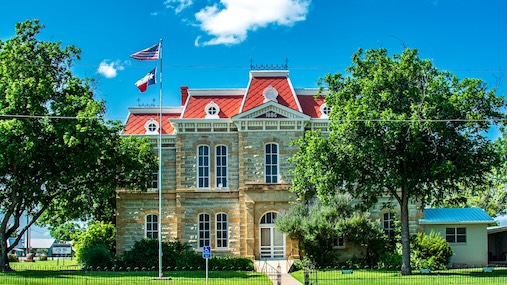
We loved the Concho County Courthouse so much that it made our top ten list. The building is one of the oldest continuously operating courthouses in the state, having been built in 1886. Those exact numbers over the front door remind us that our ability to settle disputes peacefully contributes to a liveable society. For a building over 130 years old, it is remarkably well-preserved. The limestone looks freshly quarried.
The Ruffini brothers were the design team. They were prolific architects out of Austin, responsible for several other courthouses and the original main building on the University of Texas campus. Before moving to Texas, brother Oscar worked for the firm that designed the Texas Capitol. Oscar was forced to carry on alone on this project when his brother “F.E.,” died before completion.
The style is Second Empire, meaning it roughly matches much of Paris (France, not Texas) that was built during Napoleon’s second reign. As Napoleon liked, a Second Empire building tended to the monumental and the ornate. The iron casting you see in Paint Rock is a common feature, as is the mansard roof. I typed “mansard”, but I confess that I had to look it up to discover that the term refers to a roof with four sloping sides with a steeper pitch in the lower half. Check that box in Paint Rock.
The difference the roof makes is that it replaces a dominant feature, such as a rotunda, clock tower, or bell tower. Personally, that style gives an Old West feel in a county where it is appropriate. She has stood the test of time and is one of our favorites. I am sure Napoleon would also approve.
Things To See And Do
A little orientation is in order. The county seat is Paint Rock (population 237), but the largest town is Eden (population 1,100). Eden is also located at the intersection of State Highways 87 and 83, while Paint Rock is only on SH 83. As the larger and more trafficked town, almost all of the commercial activity is in Eden, and you are more likely to stumble on it without a detour. Of course, you are not going to Concho County for “commercial activity” anyway. If you are looking for shopping options outside of Eden, we suggest San Angelo (Tom Green County), Ballinger (Runnels County), Brady (McCulloch County), or Coleman (Coleman County) as nearby alternatives.
Most tourists are there to fish at O.H. Ivie Reservoir or to hunt. The lake was a long time in the making, with the general idea proposed in 1938 and the dam christened 52 years later. The result is 19,000 acres of water shared by Coleman, Runnels, and Concho counties. By far the largest of the area’s lakes, it also features “sharelunkers,” or some of the biggest largemouth bass in the state. Deer, exotics, dove, quail, turkey, and hogs are all in your targets in the area. We have a list of the many ways you can achieve your goals in the “Where to Drop a Dime” section.
Of course, you will not be anywhere near the first hunter in the area. That tradition dates back centuries to the Native Americans, who left a history of their activities through the petroglyphs on the rocks above the Concho. This is real history, of the highest quality, rivaling that of anywhere in the country. Take the tour.
Both the Concho and the Colorado are technically “floatable,” but the Concho often runs shallow, requiring portages. The best bet is either a put-in near where the Concho and Colorado merge to the northwest of the lake or the Colorado south of the lake. Paddling the lake or kayak fishing is a great idea. There are several public boat ramps and campgrounds, accommodating both RVs and tents.
One of our favorite roadside stops ever was the “Garden of Eden” in Eden. While your first thought was biblical, the name derives from the town’s founder, Frederick Ede. Whatever the naming convention, the garden club maintains a first-class garden well worth the short tour. On the weekend, the Don Freeman Memorial Museum in Eden will provide more details about the area’s history. On occasion, you can catch live music or other cultural events at the Green Apple Arts home building.
Food, Drinks, And Music (Eat Local!)
The restaurant business in Concho County intersects on the low end of the supply and demand lines. Our biggest recommendation is On the Square Bakery & Deli: limited hours, but great deli lunches and treats for the road. Morocco’s Cafe offers traditional Tex-Mex with a touch of California Baja, along with an American menu. Mexico City is a reliable Tex-Mex restaurant offering a menu and buffet. While not a seated restaurant, Venison World is a must-stop location for sausages and other meats you can cook at the campsite. This is the real deal as far as deer meat. All four are in Eden.
On the Concho County side of O. H. Ivie, Dillion’s Smokehouse is a weekend-only Barbecue and live music spot that looks perfect for a lake getaway. Concho Park Marina features a casual waterfront diner.
Where To Drop A Dime (Shop Local!)
In Eden, Schumann’s is a quality boutique and fit store, while The Fig Leaf is great for treasure hunting vintage finds. A truly unique gift for yourself or others would be a custom knife from Blackwell Custom Knives. Call ahead on the knives. Other than that, there is no specialty shopping to speak of. Instead, opt for local knowledge and experiences (code for guided hunts) at:
Caffey Bar 6 Game Ranch, (325) 869-3221
Heart of the Lonestar Ranch, (325) 869-5285
Maverick Creek Ranch, (318) 470-5431
McMurtrey White Tail Ranch, (325) 869-5145
Millar Bow Hunting, (325) 869-5525
Real Outfitters Eden Hunting Ranch
6 of Hearts Fishing Club, (325) 869-5100
Alton Hall Ranch, (325) 869-4304
Chapparal Ranch, (210) 420-7150
Dos Amigos Ranch, (512) 480-9700
El Sueno Ranch, (325) 456-9853
White Point Ranch, (325) 456-9368
Special Places To Lay Your Head (Stay Local!)
Most of the entries in the hunting section include lodging. Great if you are hunting there, but often the cabins will be available to non-hunters in the off-season. For convenience, these lodges are listed again at the bottom of the section. You can also check the RV resorts (For the Professional Traveler) for cabins. Other unique opportunities include Peach Tree Guest Haus, a quaint short-term rental in Eden, and the Chapparal Ranch, a wedding venue.
Potential lodges:
For The Professional Traveller (Campgrounds and RV Parks)
Special Events
The livestock show happens each January. Fall Fest is the fourth Saturday of September each year, with vendors, food trucks, kids’ activities, and a street dance. Paint Rock Excursions celebrates the Summer and Winter Solstices. Eden hosts an annual appreciation of hunters and hunting at the Camouflage Cotillion, a name we love.
Fore! (Golf Courses)
Concho Springs Golf Course in Eden is a quality nine-hole public course with significantly different tee boxes that create an actual 18-hole experience. Offering some of the better greens in West Texas and a moderate difficulty layout.
816 US 83
Eden, TX 76837
(325) 869-8180
Getting to Concho County
Look for almost the exact center of the state, then move slightly west. Just slightly. The closest city is San Angelo, which is 30 miles west of Paint Rock and 45 miles west of Eden. The major roads are State Highway 87 (running east-west) and 83 (running north-south). Those two roads intersect in Eden, with Paint Rock being about 20 miles north of that intersection on Highway 83. Paint Rock is roughly the midpoint between Interstates 10 and 20, with Junction (on I-10) and Abilene (on I-20) each approximately 70 miles away. The state’s actual geographic center in Brady is 50 minutes to the southeast of Paint Rock.
If you want to fly in, San Angelo and Abilene each handle American Airlines commuter flights, all of which are routed through DFW International. For other major carriers, the best bet is San Antonio International Airport, but that is almost three hours by car to Paint Rock. Austin Bergstrom is slightly farther. For smaller craft, Bruce Field in Ballinger is just 17 miles north of Paint Rock. Otherwise, the Menard County Airport (42 miles south of Paint Rock), Curtis Field in Brady (50 miles southeast of Paint Rock), or Coleman Municipal Airport (54 miles northeast of Paint Rock) are all reasonable options. Distances to Eden can be about 20 miles different, so if that is your destination, you would likely favor Menard or Curtis field in Brady.
History
The abundant water supply in Concho County, originating from the Colorado and Concho rivers, drew Native Americans to the area as far back as 10,000 B.C. The dominant culture in the 1600s was the Jumanos, who allied with the Spanish, seeking protection from the Lipan Apaches. Although the Spanish built a temporary mission and fort in the area, they withdrew quickly, and the Apache came to control the area in the late 1600s and 1700s. Through the 1800s, the Apache and the Comanche traded control of the region.
In the mid-1800s, settlement touched on the area that was to become Concho County without establishing anything permanent. The area was first surveyed in 1847 as part of projected German immigration. A few years later, a short-lived settlement emerged as a way station on the trail to California, frequented by gold seekers. That stop did not last long as the whole trial moved south. The legislature established the county in 1858, but formal organization did not occur until 1879. In the interim, the native American threat dissipated with McKenzie’s victory at Palo Duro and free-range cattle became popular in Concho County. In addition to local cattle operations, near cattle drives along the “Western Trail” passed through what is now Eden.
In the 1880s, the railroads made their way to Ballinger, close enough to move goods to for transport. It would be another several decades until the rail lines appeared in Concho County. With no manufacturing to speak of and no prime trading locations related to the railroads, Concho County has always been a farm and ranch county. The primary crop was cotton through the depression, and the primary livestock was cattle. In the second half of the twentieth century, sheep became an increasingly important livestock species, while wheat and sorghum began to occupy large areas of land that had previously been used for cotton fields. Modest oil production began in 1940. By 1988, Concho County was the largest wool producer in the state.
Today’s economy looks similar to that which existed at the turn of the century–medium-sized ranches with cattle and/or sheep complemented with medium-sized farms combining cotton and feed grains. Concho County politics mirrors that of other rural, agricultural counties. Specifically, the county’s loyalties lay with conservative Democrats up to Nixon’s election in 1968, bounced back and forth a bit through the end of the century, but generally solidified behind the GOP during the Reagan years, and have become increasingly deep red in recent years.
Today, Concho County is 61% Caucasian, non-Hispanic; 31% Hispanic; 4% African-American; and the remaining 4% is comprised of individuals of mixed heritage and various other ethnicities. The population skews older than the national and state averages, with less educational attainment, particularly in post-secondary education. While the median income is approximately 80% of the state average, the poverty level aligns with the state average. Housing costs are noticeably lower than in other parts of the state.
James Earl Rudder, World War II hero and the transformative president of Texas A & M University, was born and raised in Eden.