


Field Guides
Columbus, Texas
(Colorado COUNTY)
River bends, German heritage, and historic charm along Highway 90.
Highlights
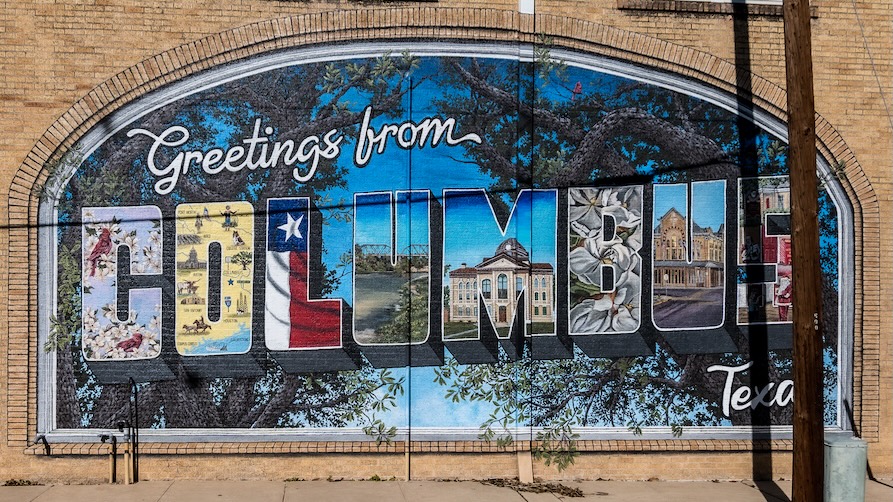
Colorado County is “one of the first” by almost any measure of Texas history, which is unsurprising given the area’s natural beauty, fertile ground, abundant wildlife, and proximity to major ports along the Texas coast. If you were a settler looking for a place to make a life, you would put down stakes here, too. Today, the county seat of Columbus is easily accessible from Interstate 10, so light tourism keeps a stream of visitors stopping by.
They find a wonderfully preserved historic town with an active square and tremendous local restaurants. Many visitors time their stops to see the Santa Claus Museum, a necessity given the limited hours. The Colorado River draws anglers, paddlers, and floaters. The largest lakes in the county, Eagle Lake and Lower Lake, are private but available for lease. For hardcore wildlife lovers and historians, the Attwater Prairie Chicken Refuge preserves a unique species and offers a beautiful nature walk.
Most of the tourism, however, relates to fishing and hunting. As you will see, it is among the best in the state. Colorado County is a delightful, easy stop for those who want to touch another era or enjoy some time in the great outdoors.
The County Courthouse
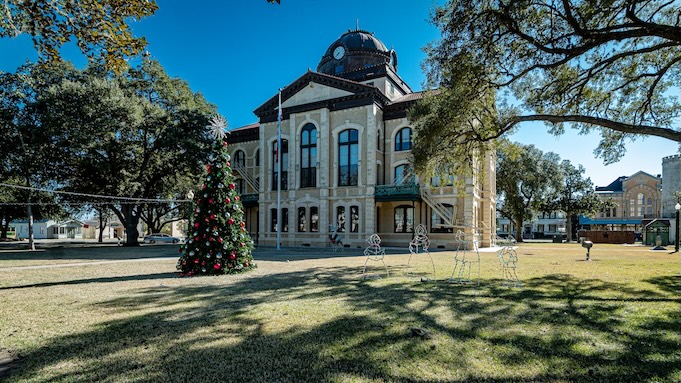
You will see in our history session that there have been administrative and judicial proceedings in Colorado County as long as anywhere in Texas. The area saw some of Stephen F. Austin’s “Old 300” original settlers start their Texas life there. Colorado County was one of the 23 counties organized to administer the new country when Texas gained independence. So there has long been a need for a courthouse.
Legend has it that the first courthouse was entirely wood. As in, the court was conducted under a tree, now known as “The District Tree.” Unfortunately, the tree is dead, but a historical marker remains on Travis Street. Eventually, the bench and bar moved inside. In 1847 and again in 1865, the County built courthouses on the square. The second had a picket fence to keep grazing animals in the yard or out of it; we are not sure.
The County fathers fully committed with the third and current structure, completed in 1891 and designed by Eugene Heiner of Houston. Heiner was one of a handful of architects responsible for the courthouses built across the state in the late 18oos, the “Golden Age” of Texas Courthouse Construction. In addition to his 14 courthouses, not all of which are still in use, Heiner gave us 20 jails and several of Houston’s early, important buildings, including the Cotton Exchange.
Columbus is a robust effort, originally completely in a Renaissance Revival Style, a category covering much ground. Common Renaissance Revival characteristics evident in this building include symmetrical construction with exterior delineation of the floors, masonry stone as an outside surface material, and a liberal use of arches. Another aspect of Renaissance Revival structures is roofs with minimal pitch. The building became even more identifiable in this manner after a 1909 hurricane ripped the roof off. The current dome was not original. Instead, the feature was part of the hurricane repair completed in 1910. When the Courthouse was restored (project completion in 2014), the county decided to keep the 1910 design rather than fully reverting to 1891. The result is impressive.
Things To See And Do
Columbus is one of the best-preserved, really old towns in Texas. The county square is a prime example. In addition to the courthouse, the Stafford-Miller mansion and Stafford Opera House are on the square. In fact, they are next to each other by design. Mr. Stafford could see what was going on in the Opera House from his bedroom, and he was saving money on tickets, we guess. It may also have worked in reverse. A historic preservation trust maintains the Opera House. Tours are available by appointment. The house remains in the hands of the family who purchased it from the Staffords.
Those are just the starting points. A ramble around the block and the adjoining neighborhood takes you to a historic Mason’s Lodge that also housed a female seminary and the city’s first public school, two absolutely gorgeous churches (Methodist and Church of Christ), and a well-preserved 1836 log cabin. All of the buildings are well-maintained, and none of them are new. Several downtown retail stops are worth exploring, detailed in the Where to Drop a Dime section.
Also near downtown is a tree that exemplifies the town motto, “City of live oaks and live folks.” The Columbus Oak is likely more than 500 years old, one of the largest trees in the state, and beautifully gnarled. It is a natural wonder and selfie-worthy.
Friday afternoons are the best time to visit Columbus, if you believe in Santa. The Santa Museum is one of a kind in Texas, if not the whole South.
Several outdoor options exist before your Santa visit or on a Saturday morning. The Colorado River runs right through Colorado County. The bass, catfish, and crappie run right with it. You can fish from the banks or put in at Beason’s Park or the State Hwy 71 bridge. If you do not want to fish, the paddling is spectacular. Ratliff Creek, when full, is another great spot. Take the kids to Splashway Waterpark in Sheridan for more adrenaline-inducing water activities.
Or if you want to avoid the water, look to the sky. The Texas coast is famous for its bird watching. All those birds move through Texas in migratory patterns, and Columbus is a great place to see them. Attwater Prairie Chicken Refuge is a U.S. Fish & Wildlife refuge used to protect the Prairie Chicken, a ground grouse that is an essential link in the coastal ecosystem. The nature trail or even the driving loop allows one to observe other flora and fauna.
Given the lush countryside with abundant cover and plenty of water sources, the hunting has to be good. Let’s go one better on the scale; it is great. White-tail deer, turkey, raised exotics, waterfowl, and more are targets. There are guides and private ranches explored in Where to Drop a Dime. Those are many multiples of a dime, but you will get your money’s worth.
Brewed on-site beer is at Hound Song Brewery, and for winetasting, there is Whistling Duck Vineyards and Winery in Wiemar. For live music, check the possibilities at Shaw’s Bend Social Club (rodeos also), Hounds Song, the patio at Magnolia Society, Jugheadz Saloon, Lamberto’s Main Street in Eagle Lake, or one of approximately 40 churches in the county, though only on Wednesday evening and Sunday morning for that last entry.
For culture and history beyond the Opera House, the Live Oak Art Center has exhibits and events that are well worth your time. The Prairie Edge Museum in Eagle Lake tells the local history story.
Food, Drinks, And Music (Eat Local!)
Columbus ranks right at the top for exceptional restaurants per capita. As we noted, it is an easy stop off I-10. There is zero reason to drive that road hungry. We will highlight the local favorites first and then list all the other culinary possibilities by category.
Schobels’ Restaurant is the most famous. It has operated for almost 50 years and remains in the founders’ family. Down-home cooking and hospitality produce something special. The restaurant also produces NFL football players. Three of the family members played in the NFL. We are suckers for the drive-in hamburger stand with shakes and ice cream treats. One of the best anywhere is Dairy Cone. We are a state of carnivores who are never far from their prey in the form of casual dress, great food steakhouses. Nancy’s Steak House does the casual steak thing as well as anyone. ON the other end of the spectrum is Camellia Grill, the new “big dog” restaurant at the spectacular Big Easy Ranch (more on the Ranch later). The Big Easy is “Texas Enhanced Rustic” turned up to 11.
Of course, Mexican. On a local’s tip, we tried Los Cabos Mexican Grill. Woo-hoo. Pro tip: believe their sauce description and have some extra tortillas ready to soften that heat. Finally, Columbus can do elegant/celebrate something special, too. Magnolia Society would be at home in River Oaks, but you get a slight price break here. Classic Italian served in a well-appointed Southern mansion is the next date night option at Lamberto’s Brandon House Bistro. Those are seven spectacular options across the gamut of food.
But wait! There is more. Blake’s Kitchen & Kocktailz serves up-to-date American cuisine in an industrial chic space, accompanied by great cocktails. On top of their excellent beer, Hounds Song serves excellent sandwiches and other tavern food. In nearby Eagle Lake, great Italian cuisine is still available in a more relaxed setting at Lamberto’s Main Street. Good barbecue is available from Jerry Mikeskas BBQ & Catering. Adventurous barbecue with good word of mouth is at Woods BBQ (a food truck) in Columbus, Austin’s Barbecue and Catering in Eagle Lake (a barely converted gas station), and Roadhouse in Alleyton (an actual gas station). Excellent Texas cafe food and service are available at Dewberry Cafe in Columbus, Pilsner’s Place Cafe in Alleyton, and Texanos American Grill in Garwood. Grandma’s fried chicken is the best, but if you want to give her a day off, order from Hartz Chicken Buffet. Feeling like a gourmet breakfast to start the day? Lucy’s Wine and Coffee Bar meets your needs. So does Louisa’s Pancake and Waffle Shop in Eagle Lake.
More Tex-Mex is a must. Maria’s Mexican Cafe, Taqueria Rio Verde, and Tacos El Gordo stand ready in Columbus. Eagle Lake has Taqueria Azteca and Taco Tony’s. El Buen Sazon (bring your high school Spanish), Leticia’s Mexican, and Los Jarritos are in Weimar.
For Asian cuisine, there is Formosa Chinese in Columbus or Pho109 in Eagle Lake..
Nightlife
We are repeating ourselves with some of this list. Still, for late-night bar fun, your list near Columbus is Shaw’s Bend Social Club (rodeos also), Hounds Song, the patio at Magnolia Society, Miss Molly’s Icehouse, and Jugheadz Saloon. Try the Weimar Tavern outside of Columbus if you want a dive-bar cold beer.
Where To Drop A Dime (Shop Local!)
Columbus will be the town you want to browse in. While there is likely no “all-day, stroll and purchase” setup, several stops are worth making. Our favorites are a trio of food-related shops, Against the Grain (a bakery and baking supply store), Keyser Meat Market (an old-school butcher, bring your Yeti), and OST Creamery (ice cream of the best type). The knowledge in these places is more valuable than the products. Take your time and talk to the proprietors.
At least two vintage stores should draw you in at Grand Oaks Antiques & Vintage and Hometown Goods. Of course, we have the boutique circuit. Silver Barn, Donna’s Attic, Lola & Co. Boutique, and Chicas Clothing Boutique make for a nice round trip.
You can also buy local knowledge and access, particularly for hunting expeditions. Let’s start with what is likely a wish list item for most of us. The Big Easy Ranch is a luxe outdoor resort that offers hunting, sport shooting, and fishing. You will do the opposite of roughing it when you bunk at night or chow down. If you ever wanted ot be a gentleman rancher, this place might let you do it for a weekend. Oak Creek Ranch is also fabulous, but a little more real-life. Dirty Texas Outfitters, Vara Ranch, Top Flight Hunting Preserve, Wolf Pen Hunts, Frebo Ranch, C & J Ranch, The Texas Duck Ranch, Garwood Hunting Club, Bucksnag Hunting Club, Yard Bird Hunting Club, The Ranch TX Private Shooting Club, and Riceland Waterfowl Club are all options. Picking the one that best suits you is up to you!
Special Places To Lay Your Head (Stay Local!)
Obviously, all the lodges we listed in Where to Drop a Dime are special places for hunters and fishermen to bunk. The Big Easy appears to pull off the impossible: a lodge where a guy could hunt, fish, and golf on his honeymoon without endangering the marriage. Setting these specialties aside, Columbus and Colorado County have some great overnight offerings, but they fall into the short-term rental or bed and breakfast category.
36 Oaks Retreat is perfect for family or corporate groups.
The Lazy B, Mae Mae’s Cottage, or Mary’s Nest would fit smaller groups or couples. VRBO has lots more.
For The Professional Traveller (Campgrounds and RV Parks)
Special Events
Fore! (Golf Courses)
We have opposite ends of the spectrum here. The Big Easy Ranch is deee-luxe. A championship-level 18-hole track, quality old-fashions to erase what it did to you, and a nine-hole practice track to sharpen your attack the next time. The Columbus Golf Club is a straightforward nine-holer. Pretty also.
Big Easy Ranch
2400 Brunes Mill Rd.
Columbus, Texas 78934
(979) 733-8635
141 Veterans Dr.
Columbus, Texas 78934
(979) 732-5575
Getting To Colorado County
The directions are among the simplest for any county in Texas. It is 65 miles west of Houston on I-10 or 120 miles east of San Antonio on I-10. Austin is 90 miles northwest on State Hwy 71, which meets I-10 at Columbus. That puts Columbus three hours, 25 minutes of drivetime southeast from the state’s geographic center in Brady.
If flying on a major carrier, you will land in Houston at Hobby or George Bush Intercontinental or in Austin at Bergstrom before hopping into the rental car. Hobby handles the bulk of Houston’s Southwest flights, along with Delta and American sprinkled in. Intercontinental and Bergstrom are open to almost all carriers. The airports are equidistant from Columbus. Smaller craft can land at Robert R Wells Junior Airport in Columbus or Eagle Lake Airport, each in the county. Wharton Regional Airport is an option if the locals cannot handle you.
History
Colorado County does not feel particularly coastal, but it is only 80 miles from the nearest coastal bay, closer as the crow flies. Thus, the Karankawa and the Tonkawa of the coast were frequent inhabitants of the areas for at least 10 millennia before Europeans showed up. Those early European expeditions, which often had starting points determined by shipwrecks in the general area of Port Lavaca, repeatedly tromped through the area.
As every Texas seventh-grader knows, Mexico authorized Stephen F. Austin to bring 300 families (the “Old 300”) to Texas. Those families received land grants totaling more than 1.5 million acres. While the administrative offices in San Felipe de Austin did not issue the grants until 1824, the families had settled in well before then. Almost all the settlers chose land by the rivers, which was only logical. As a result, the first land grants trace the Brazos and Colorado rivers as they wind their way to the coast. The group along the Colorado concentrated near present-day Columbus. William Buford Dewees was a leading settler in the area.
When war erupted, the area’s proximity to San Felipe de Austin put everyone at risk. As Sam Houston simultaneously retreated and attempted to enlarge and transform his Army in the Runaway Scrape, he and Santa Anna spent about a week, only two miles apart, in what is now Colorado County. Dilue Harris was ten at that time and keeping a diary. Her account is an important historical resource detailing the weeks when the revolution teetered on the brink of disaster. Dilue’s preserved home stands in Columbus to this day.
With independence, Colorado County grew rapidly from two sources. A plantation economy sprang up as cotton increased in importance as a cash crop. Thus, Colorado County became a leading slaveholding county. At the same time, significant German immigration led to a large settlement in Frelsburg. The Germans were Unionists, and the plantation workers. The secession vote was close, with the Confederate side barely prevailing. With the war at hand, large numbers of Colorado County men joined the Grays.
On their return, they found a devastated economy and social structure. As can be imagined, Reconstruction saw much strife in the area. Blacks held public office while KKK-like organizations practiced intimidation tactics. Ultimately, the intimidation and the poll tax restored a semblance of the old order, which lasted until the 1950s at least. The county’s demographics were constantly changing, as more European settlers and Hispanics immigrated to the area while blacks emigrated out. The mix of agriculture often varied. Cotton declined while rice and dairy increased. Corn, sorghum, and other crops played a role. As the 20th century progressed, oil also contributed to the economy. While never dominant, fossil fuels played a noticeable role.
Colorado County remains too far from Houston and Austin to be a commuter city, but millions of cars pass by monthly on I-10. The economy remains a mix of agriculture, energy, light industry, retail, and services. Also unchanged is the natural beauty that must have drawn William Buford Dewees, his family, and friends to the area over 200 years ago.
As of 2023, Colorado County’s racial/ethnic demographic was 35% Caucasian, non-Hispanic. 30% Hispanic, 13% African American, and 22% divided among mixed and other races. After 200 years and all the complications, Colorado County looks a lot like the state as a whole. The median household income and educational achievement in Colorado County remains below state and national medians, but has made gains in the 21st century.
As with all of rural Texas, Colorado County was long a stronghold for conservative Democrats. That allegiance dipped in the 1950s, flickered back to life when Lyndon Johnson was on the national ticket in 1960 and 1964, and has steadily declined since then. In the most recent presidential election, 78% of the County voted for President Trump.
Colorado County has produced at least 13 NFL players–Willis Dean Adams, Allen Aldridge, Sr., John Ashton, Kevin Dogins, Dan Edwards, Ken Kooonz, Tex Leyendecker, Roland Mitchell, Alfred Ogelsby, Aaron Schobel, Bo Schobel, Matt Schobel, and LaAdrian Waddle. That makes the area’s six major league baseball players seem small in comparison. But the name you are likely most familiar with is in your refrigerator. Gail Borden, who perfected condensed milk, among many other accomplishments, spent the latter part of his life in Colorado County.