


Field Guides
Robert Lee, Texas
(Coke COUNTY)
Windmills, dry plains, and quiet resilience in the heart of West Texas.
Highlights
The countryside. Coke County may be Texas’s best-kept secret for natural beauty. The county only holds 3,000 people, so the world-class museums, the cutting-edge restaurants, and the fashion-forward boutiques are tough to find. There is real history at Fort Chadbourne, but other than that, everything is entirely rural. Ranching and farming drive the county.
What a beautiful spot to do it in. The county is in the Colorado River Valley with red soil; the musical phrase “Red Dirt” perfectly describes it. There is some elevation at around 2,000 feet above sea level, with gently rolling hills, covered in a wide variety of grasses. At the center of the county is the E.V. Spence Reservoir, a 14,000-acre stunner. The lack of population pays off here as one can appreciate nature without the annoyances that fellow travelers bring. There is both subtle drama and a true gentleness to the lake and landscape.
State HWY 158 neatly bisects the county and takes you by the lake. It is one of the prettiest drives in Texas. Take advantage sometime.
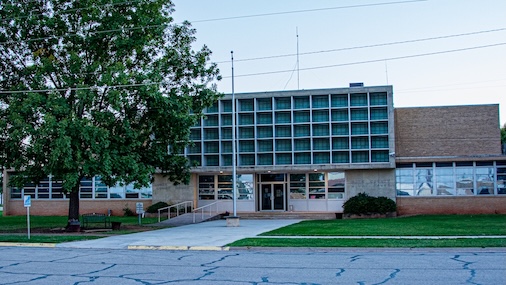
The County Courthouse
The current version is the second seat of justice in Coke County. Built in 1956, the courthouse is modern and stark. It has ultra-clean lines and a front facade dominated by windows. While the design suggests efficiency, to our eyes, it does not fit the county’s character. Mid-mod is better in a residence than a courthouse and more fitting in Palm Springs than rural Texas. The prior version, which served from 1891 to 1956, was more traditional, up to and including a windmill on the front lawn. Good old days syndrome is a real thing.
Things To See And Do
Fort Chadbourne is located on the eastern edge of the county, next to the Oak Creek Reservoir and the small town of Blackwell. The fort is unique and historic in several ways. It was active only from 1852 to 1873, during which the Civil War caused possession to be transferred from the Union to the Confederacy and back. The most celebrated resident of the fort was Robert E. Lee, which is why the county seat is named “Robert Lee.” Several other generals who gained renown during the Civil War spent time at the fort.
Legendary Texan Samuel Maverick acquired the Fort after decommissioning, and his widow sold it and the surrounding acreage to Thomas Odom in 1877. The land remains with Odom’s dependents to this day. A foundation oversees the Fort and its restoration. The visitors center is impressive, and Texas’s military, ranching, and Native American history are well presented.
This is the great outdoors, and there are plenty of hunting opportunities. Deer of all types, hogs, and turkeys are the prime targets, but there are exotics also. Fishing can be done at both the Spence and Oak Creek reservoirs.
Photographers might enjoy a side trip to Sanco, a small ghost town (three buildings) with a robot sculpture. It’s odd but enjoyable.
Food, Drinks, And Music (Eat Local!)
The headliner in the county is Blue Agave Cattle Company in Blackwell, an excellent steakhouse with the possibility of live music. Also in Blackwell is the Blackwell City Cafe for comfort food and Blackwell BBQ. Robert Lee, the county seat, has Another Place Cafe, which gets Texas Ten’s seal of approval as we stopped there one evening after Stella encountered a large porcupine. It was a calming experience. You can get your Tex-Mex fix at Rangel’s Mexican Restaurant, both in Robert Lee and in Bronte. Finally, Bronte enters the Coke County cafe sweepstakes with the Pena Red Barn Cafe. The Coffee Table in Bronte also offers breakfast and simple lunches as a side to their excellent coffee.
Where To Drop A Dime (Shop Local!)
If you have extra cash, Bronte is the most interesting stop. Bronte Guns and Tackle is the best spot for outdoor supplies. El Rancho Western Wear and Thankful Ladies Boutique up your style game. For browsing vintage items, try the This’n That Shop in Robert Lee.
For hunting endeavors, check out Texana Ranch, Weather Rock Ranch, or 1892 Outfitters (972) 510-7400).
Special Places To Lay Your Head (Stay Local!)
In addition to the hunting lodges (Texana Ranch and Weather Rock Ranch), the Ivey Courts Motel is a revamped Western motor court, and there are several short-term rental options.
For The Professional Traveller (Campgrounds and RV Parks)
Colorado River Municipal Water Authority–Four public campsites on or near E.V. Spence Reservoir
McWhorter’s Oak Creek Lodge (On Oak Creek Reservoir)
Sportsman Lodge (On Oak Creek Reservoir)
Special Events
With only 3,000 people in the county, there are no huge events. The Livestock Show is held each January.
Fore! (Golf Courses)
There are two nine-hole courses in the county, Mountain Creek Golf Club and Bronte Longhorn Golf Club. Both are public, inexpensive, relatively short, and fit for a good time.
Mountain Creek Golf Club
170 County Park Rd.
Robert Lee, TX 76945
(325) 453-2317
Bronte Longhorn Golf Club
250 E. Park Rd.
Bronte, TX 76933
(325) 473-2156
Getting To Coke County
Coke County sits close to the middle of the state, a bit north of San Angelo and south of Sweetwater, which is on I-20, 57 miles away. No other interstate is within shouting distance, even at full volume. Rural is an understatement. State Highways 158 (east/west generally) and 277 (north/south generally) intersect near Robert Lee. All that puts Robert Lee about an hour and a half of driving time northwest of the state’s geographic center in Brady. Windshield time from other Texas cities can be found here.
If you fly, the nearest big airport is DFW International, over four hours to the east. American regional service through DFW is available at San Angelo Regional Airport (45 minutes away) and Abilene Regional Airport (an hour and a half away). Midland International (two hours) adds Southwest and United options to American. For smaller craft that do not want to use San Angelo, Coke County operates a municipal airport in Robert Lee.
History
There is little known history of present-day Coke County before the Plains Indian area. From approximately 1700 to 1870, the Comanches ranged the area, competing for game with the Tonkawa Indians to the east and Lipans to the west. In 1851, the US Army established Fort Chadbourne to “protect the frontier” and manned it until the Civil War. Most famously, Robert E. Lee spent some of his time in Texas at Fort Chadbourne. In addition to General Lee, other Confederate stalwarts who served at Fort Chadbourne included James Longstreet, George Pickett, Albert Sidney Johnston, and John Hood.
From 1858 to 1861, this area was part of the Butterfield Overland Mail route, taking advantage of the protection offered by Fort Chadbourne. In 1865, hide hunters came to the region, depleting its buffalo population and ushering in a new era of bone collectors who would gather bones left from the discarded carcasses, bleach them, and ship them from Abilene and Colorado City. At this time, the land in this area was determined by “gentlemen’s agreements” respecting “range rights,” but this arrangement did not last long. Nor did Fort Chadbourne, which was decommissioned in the late 1860s, based on supply and water difficulties.
In 1882, the Texas and Pacific Railway expanded service through this area, but a severe drought and subsequent fence cutting led to disputes and the destruction of land out of desperation. It wasn’t until 1889 that the Texas Legislature established Coke County, named after Texas Governor Richard Coke, and designated Hayrick as the county seat. In 1891, however, the county seat’s name changed to Robert Lee after its well-known, if temporary, resident.
Despite many challenges, the settlers persevered. Despite the loss of the fort, the Union Army’s eventual military success and removal of the Native Americans to Oklahoma led to the Anglo type of civilization. That process is most evident in the settlers showing an affinity for literature and naming the small towns of Bronte and Tennyson after famed English writers.
By 1900, the county had more than 480 farms with over 605,000 acres dedicated to ranching. Coke County is among the leading sheep ranching counties in the state, producing nearly 90% of the county’s agribusiness with feed grains, cotton, and fruit farming, adding to the bottom line. The early 1900s ushered in the Cotton Culture and a growth in population and business ventures. The Depression and a boll weevil outbreak, however, halted this progress and did not improve again until the early 1940s.
In 1946, the Sun Oil drilling company (later Exxon) discovered a lucrative field, opening the way for a new era of oil and gas production in the region. As oil drilling spread throughout the county, it brought a wave of prosperity, with residents reaping the benefits of the money earned. This led to significant improvements in the community, with several parks, buildings, and amenities built, transforming the region.
Voting patterns in Coke County have followed a historically Texas trend. From the county’s inception through 1980, voting was predominantly Democratic. A shift, however, occurred in 1984, and with few exceptions since then, voting at the local and national levels has strongly favored Republican candidates.
As of the 2020 Census, Coke County had a population of 3,285 people. Of these, 19.5% hold a bachelor’s degree or higher. The population is slightly diverse, with 75% being Caucasian, non-Hispanic, 20% Hispanic or Latino, and the remainder African-American, mixed, or multi-racial. The education rates, median household income, and property values trail state and national averages by a good bit.
Coke County is proud of its frontier heritage and early settlers. That pioneering spirit continued through Moda Fincher, one of America’s first and most important female deejays, born in Bronte. John Burroughs, who became Governor of New Mexico, was a Robert Lee native.
Primary Sources: