


Field Guides
Anahuac, Texas
(Chambers COUNTY)
Coastal charm, bay fishing, and fresh Gulf air near Houston’s edge.
Highlights
Chambers County boasts a long history of independent thought and decisive action. Several leaders of the Texas Revolution got their feet wet in what would become the struggle for independence in and around Anahuac, which is now the county seat. Our history section has more details, but suffice it to say that William Barrett Travis had a surprising connection well before their fateful engagement at the Alamo. In some ways, the Texas Revolution began here.
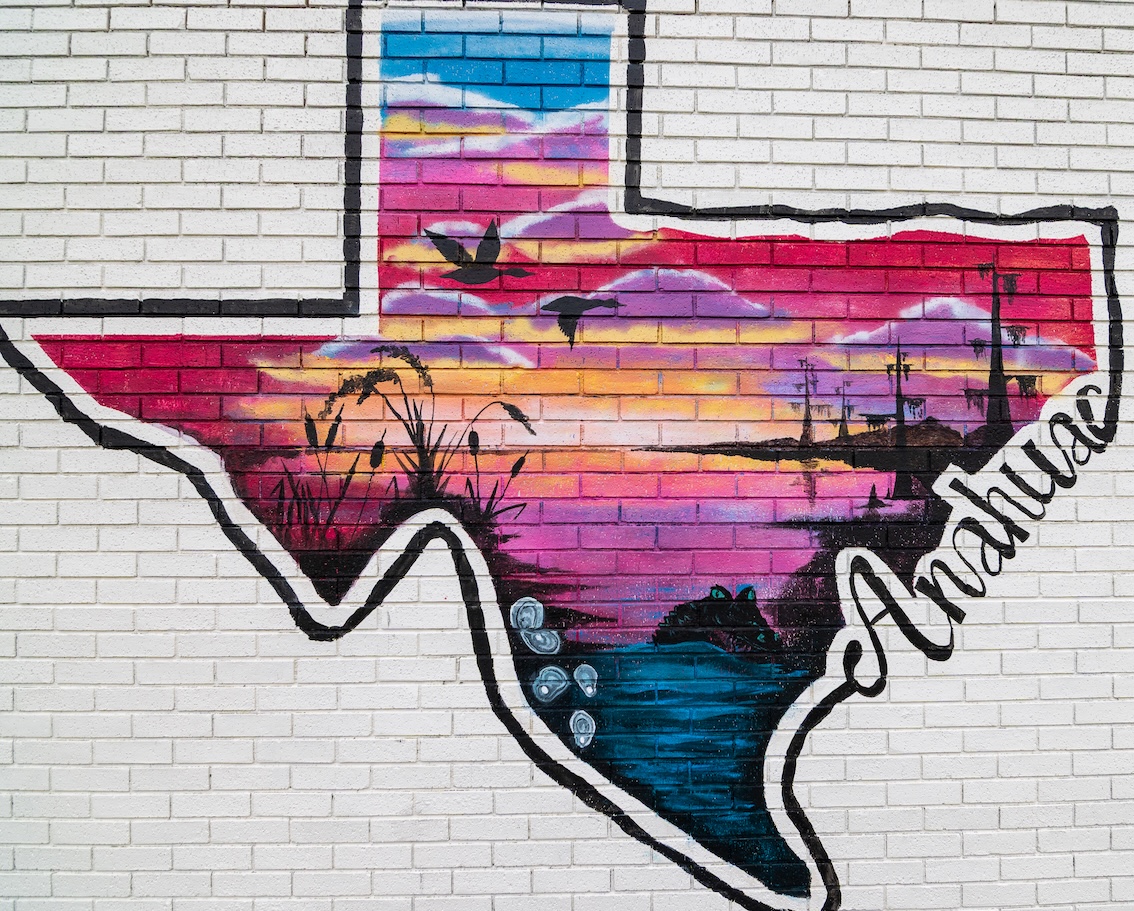
In addition to its historical significance, the county’s rich ecosystem encourages today’s rough-and-tumble outdoorsmen to enjoy fishing, hunting, and other activities. The county’s trademark wildlife is the cuddly, lovable alligator. Okay, maybe not lovable, but numerous. They are so numerous that they are said to outnumber the human population by three to one. Enough that the area is now known as the “Alligator Capital of Texas.” Texas Gatorfest, the annual celebration of the American Gator, is the area’s biggest party.
Beyond the history and the gator adventures, almost half of Chambers County’s border fronts the large bays connected to Galveston Bay. There are also significant inland lakes. As you might guess, fishing and hunting are popular activities. Alligator hunts, of course, but the opportunity for waterfowl is among the best in the country.
The County Courthouse
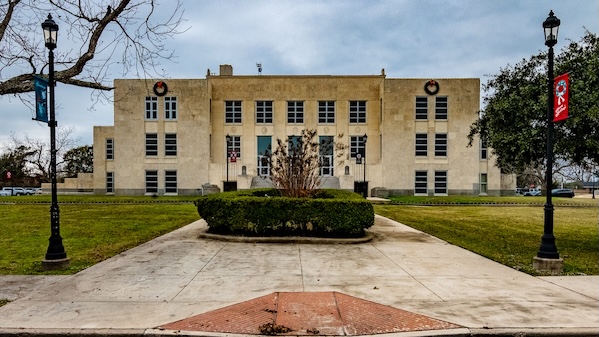
As with so many courthouses, the Chambers County structure replaced two previous versions that had been destroyed by fire. This edition arose in 1937. A three-story modern structure built with a limestone exterior, the courthouse dominates the town. Built during the depression by the WPA, the courthouse is a bit ironic given the county’s long-standing stance against an interfering central government. The climate allows the keepers to keep the surrounding lawn green and lush. As a bonus, there are several historical houses and replicas to inspect on the grounds or next to them. It is a courthouse that would make William Barrett Travis, who practiced law in the county, proud.
But nothing stops progress. Chambers County is in the midst of construction on a new courthouse and jail. The new construction is not without controversy, as it forces the relocation of the historic homes and structures.
Things To See And Do
Unlike most counties, the local history museum is not in the county seat. So, for an in-depth history tour, start in Wallisville, which is conveniently located right off I-10. The museum is open only during the week (9:00 a.m.–4:00 p.m.), so plan accordingly. It is worth it, as the local group is more organized and effective than similar groups in small- to mid-size counties. Take the scenic drive south from Wallisville on FM Road 563 around Lake Anahuac. Stop at the Jocelyn Nungaray Refuge Visitors Center if you want a central information point for birding in the area. The Visitors Center is open from 9:00 am–4:00 pm Friday to Sunday.
In Anahuac, visit the city center, historic houses, and replicas. From there, just a short drive south of town will lead you to the ruins of Fort Anahuac, the Mexican Garrison that caused so much trouble.
The great outdoors is next, and plenty of it. Although the refuge headquarters are north of Anahuac, the refuge itself occupies a large part of the southern end of the county. That includes substantial bay frontage and the adjacent wetlands. There are substantially raised trails and lots of viewing stations to see various birds (including golden eagles and the occasional bald eagle), waterfowl (whooping cranes), turtles, butterflies, and, of course, the alligators. Shovler’s Pond is a popular spot within the refuge to catch these animals and more. Chambers County maintains an elaborate and beautiful park system outside the national refuge, so there are endless opportunities for outdoor activities.
All that water means exceptional fishing. On the bay side, one can expect an abundance of red drum, flounder, and spotted sea trout. You can either do wade fishing or fish by boat via East Bay and Oyster Bayou. If you are looking for freshwater catches, there are opportunities in lakes, rivers, and marshes. While not an exhaustive list, some popular spots are Lake Anahuac, Cotton Lake, Old River and Old River Lake, Cow Island Bayou, and the Trinity River. The Shop Local section provides information for local guides and bait shops that can provide up-to-date fishing conditions.
Hunting is just as exciting. Ducks, geese, and alligators provide the headlines. Again, Shop Local! has your necessary resources.
If you like wine in a relaxed setting, try the Frascone Winery. The tasting room is open Thursday through Saturday from noon to 6:00 p.m.
Food, Drinks, And Music (Eat Local!)
There are plenty of choices in Chambers County. To make the correct one, you first have to define your needs. The bulk of the restaurants are near I-10 in Wallisville and Mont Belvieu. There, you get variety and longer operating hours, but in many cases a slightly more corporate feel. In Anahuac and nearby Doubly Bayou, you have more authentic “down-home eats” and an occasional lake view without anything approaching fancy. Regardless, you will have fun and good food.
One additional note. A sliver of Baytown is in Chambers County, but that city is mostly in Harris County. If you see a Baytown address on a restaurant, it is on I-10, immediately next to Mont Belvieu.
For that true “relaxing at the lake” vibe, Snappy’s Roadhouse or The Crawfish Place, each close to Lake Anahuac. In Anahuac proper, a trio of Tex-Mex places will satisfy your south of the border cravings: The Beginning, Nopalitos, and Mirandas. Gator Fruit N More serves tacos, quesadillas, and adds foods you would find at a fair, such as hot dogs, nachos, cheesy Cheetos, and corn-in-a-cup. Tony’s BBQ (also in Mont Belvieu and Winnie) checks the other must-have Texas food group box. Being near bodies of freshwater and saltwater, there’s a good chance you’ll be craving some seafood. The Crawfish Place in Anahuac, as well as Double Bayou Crawfish Farm & Boil House in Double Bayou and Crawfish Hideaway in Anahuac let you get your Cajun on. For all the seafood feels, Channel Marker 17 is the local favorite.
Closer to I-10 in Mont Belvieu, we start in the “elevated roadhouse, okay for date night” category with two stellar entries in Cactus Jack’s and Craft 96 Draught House & Kitchen. For fine cocktails paired with fine bar food, try Coctel Lounge. The closely related traditional diner group also has a strong representation from Lercy’s Diner West and The Point Grille. We also include Beaky’s Hot Chicken here as a subset of the category. Tex-Mex gets done at Casa Julia and Iguana Joe’s. Floyd’s Mont Belvieu (Cajun), Lee’s CK Seafood (traditional), Paradise Cafe (sushi and stir fry), and Aki Steak & Sushi (traditional Japanese steak and sushi) cover the seafood species. Tony’s BBQ is blue-ribbon worthy in its grouping. We will leave the best in show decisions to you.
Wallisville is also convenient for interstate travelers and offers Gator Junction BBQ and The Park Bar & Grill. If you find yourself in rural Winnie, try either Big Daddy Eatery or Tony’s BBQ’s third location.
Where To Drop A Dime (Shop Local!)
There is no one strip or square of great little independent stores. The closest to that concept is the Lil Shops of Anahuac, a multivendor complex in a grand old building in downtown Anahuac. Urban Storm Boutique, All About You, and Small Town Branding are apparel boutiques worth checking out.
But let’s get our fish and game on! Local fishing info and all the supplies are at Lazy Pelican Bait and Tackle, Half Fast Bait Shop, and Sea Pony Bait and Tackle. For hunting or fishing guide services, Jason Catchings Service guides everywhere but is headquartered locally. There are several hunting/fishing lodges where hunters or anglers congregate. In no particular order, the Oak Island Lodge, Oyster Bayou Hunting Club, Fin and Fowl Outfitters, and Central Flyway Outfitters provide full-service experiences.
Special Places To Lay Your Head (Stay Local!)
Chambers County is for outdoorsmen and women. The unique places are geared to hunting, fishing, and avoiding alligators. Although the thread count may be a bit low, the scenery is truly spectacular. Try these:
Modern Farmhouse in Wallisville
For The Professional Traveller (Campgrounds and RV Parks)
Special Events
Alligator enthusiasts worldwide travel to Anahuac each September to celebrate their favorite reptile at Texas Gator Fest. October is a great time to visit Chambers County. Aside from the climate, Winnie celebrates with the Texas Rice Festival the first weekend of October, and then Anahuac is ground central for the eastern portion of Bike Around the Bay (these are pedal pushed, not Harley-Davidson) later that month. From mid-April to mid-May, competitive birders (yes, right) looking to win the Great Texas Birding Classic flood the county.
Fore! (Golf Courses)
You have two 18-hole layouts to choose from. Chambers County Golf Course is a municipal course that is fairly open, not too bunkered, and with plenty of water. Eagle Pointe Golf Club in Mont Belvieu is a step-up, semi-private that regularly hosts state-wide tournaments.
Chambers County Golf Course
1 Pinchback Rd.
Anahuac, TX 77514
(409) 267-8235
Eagle Point Golf Club
12440 Eagle Pointe Dr.
Mont Belvieu, TX 77523
(281) 385-6666
Getting To Chambers County
Chambers County is in the far southeast of Texas, one county removed from Louisiana on the coast. I-10, headed east/west, bisects the county’s northern portion. Mont Belvieu and Wallisville face the interstate. To get to the Anahuac, the county seat, it is FM 536 south from I-10 for about ten miles. Much of the county is the wildlife refuge, the lakes, bay, or rice fields, so the roadways are not extensive. State Highway 124 runs north/south on the far east of the county, including Winnie, while State Highways 99 and 146 travel north/south on the far west end of the county. Whatever roads you use, the county is five hours, 20 minutes of drivetime southeast from the state’s geographic center in Brady, Texas. Windshield time from other Texas cities is here.
Flying to Chambers County or close to it has all sorts of choices. Houston Intercontinental and Houston Hobby are each about an hour’s drive from the west. Intercontinental handles the major airlines other than Southwest, while Hobby is a Southwest hub with American, Delta, Sun Country, and Allegiant flights. If you want to avoid Houston, the Jack Brooks/Port Arthur Airport handles American Eagle and is an hour to the east.
The likely first option for smaller craft is the Chambers County Airport “system,” which has small fields at Anahuac and Winnie. On the west side of the bay, you might opt for RWJ Airpark or Baytown Airport. Nearby regional facilities include Ellington Airport and Scholes International Airport.
History
Chambers County’s proximity to the coast, to the formerly French Louisiana, and to shipping lanes combine to give the area a rich and colorful history. The first permanent settlers of note were the Karwankawa, whose presence in the area dates back more than a thousand years. For about the last century, the narrative was that the Karwankawa were extinct, but descendants of the tribe have recently been more forceful in telling their side of the story. It is a remarkable, complicated tale shrouded in legend, myth, and misrepresentation.
Much of that legend revolves around the people’s physical appearance. The men were large, muscular, tattooed, pierced, and scantily clad. The women were also tattooed and wore distinctive knee-length dresses of Spanish Moss or animal hide. They swam well and ran fast. The dugout canoe was common transportation as they moved seasonally between the barrier islands and the mainland.
A loose conglomerate of five clans sharing the Karnakawan language controlled the Gulf Coast from Chambers County to Corpus Christi. We know this part of the record better than one would expect because Europe and the Americas met in 1528 as the survivors of a shipwreck made their way ashore at Galveston Island. Among the survivors was Cabeza de Vaca Alvar Nunez, who took notes, returned to Europe after living among the Karnakawa for several years, and then wrote extensively about his experiences. Over the next two centuries, that event repeated itself, with survivors of La Salle’s expedition providing an update on the tribe in the late 1600s and another shipwrecked sailor doing the same in 1719.
The reports were all by survivors of failed expeditions and were likely overdramatized to deflect attention from the European failures. In the retelling, Karankawan men of above-average height became seven-foot amazons. An infrequent form of ceremonial cannibalism of deceased enemies transformed into human flesh as the people’s primary diet. Thus, the myths, legends, and misrepresentations.
What is incontrovertible is that the Karankawa civilization was no match for European settlement, largely due to the diseases the white man brought with him. As European powers began to eye the New World as important to the power and wealth of their respective homelands, France and Spain began to face off in the Karankawa area of Texas. The French arrived in 1721, and the Spanish responded by 1726. Their respective efforts were intermittent and halting, but the Spanish established the Nuestra Señora de la Luz Mission in 1756 along the banks of the Trinity River. Here, Spanish Missionaries worked alongside Orcoquiza Indians until the signing of the Treaty of Paris in 1763; when the French were removed, multiple storms and frequent Indian hostilities forced the removal of the mission to a more permanent location near Goliad.
The more frequent contact with Europeans, however, led to a sharp decrease in population that continued for a century. Stephen F. Austin’s colonists generally had peaceful relations with the tribes to the west and north, but were merciless with the Kranakawa. As their numbers declined, the Karankawas lost the ability to defend themselves and started a sad, nomadic existence in what we know now as the Rio Grande Valley and Northern Mexico. Native Americans who the United States was displacing from the southeastern portion of the country took their place, but were not as organized or rooted in the area. As a result, by the early 1800s, the French and Spanish were dominant despite being outnumbered.
Mexico gained independence from Spain in 1821 and decided that immigrants from the United States would be a good way to populate the Texas frontier. Be careful what you ask for, because you will surely get it. By 1827, cattle ranches, farmsteads, and plantations already existed, as well as a newly built lumber industry. As the ranks of former Americans grew, Mexico began to rethink its strategy during a prolonged and vicious fight over how it would govern itself.
On one side were the centralists, who favored strict control by Mexico City, and on the other were the federalists, who wanted more power ceded to Mexican states. Most Texan settlers favored the federalists and wanted Texas to be a separate state, believing they would have more control over their destiny under that form of government. And the chief proponent of Mexican federalism was none other than Antonio de Lopez Santa Anna, later of Alamo infamy. It turned bad later because Santa Anna’s core belief was that the form of government that best served Mexico was whatever form made sure Santa Anna was in power; he revoked the 1824 constitution, which was more federalist in nature.
But in the early 1830s, the Texans were all for him. One of those Texans was William Barrett Travis, a lawyer who arrived in 1831, bought land from Austin, and set up shop in Anahuac. Santa Anna’s victory over centrist forces in Tampico emboldened the Texians, including Travis, who helped form an illegal militia. The local Mexican authority was Juan Bradburn, who represented the centrist government, had a force of about 300 men at his disposal, and was locally despised for various sins, the chief being tariff collections.
A Louisiana slavecatcher hired Travis to retrieve slaves to whom Bradburn had granted asylum. Travis engaged in some deception in the service of his client. Bradburn retaliated by imprisoning Travis. Travis’ militia began an attempt to rescue him, resulting in several skirmishes. Travis’s men were vigorous enough to convince Bradburn’s superior officer that discretion was the better part of valor. The commander ordered Travis released and Bradburn reassigned. Not satisfied, Travis rallied his men and forced the Mexicans to leave for the Rio Grande. Thus, the Annahuac Disturbance of 1832 ended with no local Mexican authority to enforce the tariffs or control trade with Louisiana. The Texians liked the result.
The event repeated in 1835 when the Mexican government again sent an officer and small force to resume tariff operations. Travis again activated his men, and the Mexicans again retreated. The Anahuac Disturbance of 1835 was not quite as popular as it happened while Austin was in Mexico City negotiating, and many felt the minor revolt put their leader in serious jeopardy. Travis later apologized to Austin, but his success led him to a position of command when the revolution began in earnest. The return engagement did not turn out as well for Travis.
After the Revolution, settlement resumed, and the population grew. One of the new residents was Sam Houston, who moved into the area, buying up large tracts of land. In 1844, a fabled conflict broke out over land disputes between Charles Wilcox, a known associate of the notorious Jean Lafitte, and Thomas Jefferson Chambers, the largest property-owning resident in the area. By the time the dispute was settled, the area previously known as Liberty County was to be known from 1858 onward as Chambers County, named for Chambers. As a side note, Chambers claimed the Texas Capitol’s property. In 1925, the legislature recognized the claim and paid Chambers’ heirs $25,000 for a deed to the Capitol.
As farmers and planters moved to the area, they brought more enslaved people to work the rice and cotton plantations. Not surprisingly, the County unanimously approved secession and supplied men to the Confederate army. A Confederate fort, Fort Chambers, was built during the war as part of the coastal defense effort. Despite the fort, the area avoided being a battleground during the war, but the disputes lingered into Reconstruction.
The presence of the Freedmen’s Bureau and the building of black schools in the area caused frequent racial conflicts, particularly once the Ku Klux Klan imposed its beliefs and opposition to black voting rights. In the 1876 election, a new white primary, in addition to a new Texas constitution, imposed poll taxes, overturning many of the Republican reforms, thereby creating additional tensions surrounding civil rights. These discriminatory practices persisted for almost a century.
Through the 1900s, the marshy coastal lowlands continued to support the Rice Culture in Chambers and livestock markets for beef, poultry, hogs, and sheep. Farmlands also produced corn, feed grains, and some cotton, and the land provided salt, sand, hardwood timber, oil, and gas. Despite this, hurricanes, smallpox, and the Great Depression threatened the local economy.
Relief came in the form of the most Texan of get-rich-quick fantasies, the oil strike. In 1935, after a decade of intermittent and mostly failed exploration, Humble Oil Company led a combined effort that discovered the Anahuac Field. While not in the legendary category, the field has been a solid oil and gas producer for almost a century, and the resulting revenue has contributed to the local economy.
World War II also brought employment opportunities to Chambers County in the refineries in Baytown and in the nearby shipyards. Post-war environmental policy acts helped to further bolster the economy by creating a saltwater barrier across the Trinity River to protect rice farmers. The shrimping industry, however, saw its fair share of conflicts with the Sierra Club and other environmental groups. Despite early difficulties, several projects were completed by the Corps of Engineers, which invested in the county’s infrastructure.
Today, the economy strictly within the county’s borders remains predominantly agricultural, but a small sliver of Baytown is in the county, and the rest of Baytown borders the county. Baytown is a heavy industrial town with several city districts supporting the petrochemical industry. I-10 shortens the driving commute to Houston and its varied economy. In the end, it is a mixed bag. You may have lunch with a rtig worker, a rice farmer, a fishing guide, or a salesman for a Houston firm.
Chambers County has a growing population estimated at 56,000 residents in 2024. The racial breakdown is 61% non-Hispanic Caucasian, 27 % Hispanic or Latino, 9% African-American, and the remainder of mixed descent or smaller demographic groups. While educational achievement rates in Chambers County are close to National and State averages, the median income of Chambers County residents easily exceeds the median earned on Texas and in the nation. Chambers COunty has consistently supported Republican candidates since 1920.
As detailed, William B. Travis is the most notable historical figure who spent significant time in Chambers County. Ross Sterling, the state’s 31st governor and a co-founder of the energy behemoth ExxonMobil, was born in Anahuac. His sister, Florence, was a noted women’s rights advocate.
Primary Sources: