


Field Guides
Dimmitt, Texas
(Castro COUNTY)
Cotton fields, open skies, and a heritage rooted in hard work.

Highlights
If you eat, Castro County is to thank for that. The county consistently ranks in the top five of all Texas counties for the size of its cattle population while at the same time producing an immense amount of corn. The combination means that Castro County is one of, if not the, biggest agricultural producer in Texas. To give you a rough idea, there are about 800 head of cattle and 3,000 bushels of corn for every person in the county.
Of course, to graze that many cattle and grow that much corn, one needs lots of land devoted to those purposes. That does not leave much for people or attractions. While the countryside is prettier than one might imagine, this county is notable primarily for what it does. Dimmitt is the county seat. At slightly over 4,000 residents, Dimmitt is far from a ghost town, but it is also not a destination city.
The County Courthouse
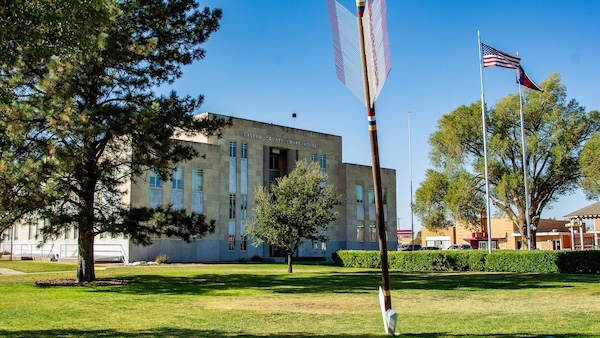
This modern courthouse, built in 1939 and opened in 1940, is the county’s third. The building’s contemporary Art Deco design features clean lines, beautiful white sandstone, and polished concrete. The lawn is open and inviting, at least as much as a courthouse can be inviting. While the motif fits the area, the giant arrow plugged into the lawn is jarring. Of course, Native Americans are the area’s origin story, but we are not sure precisely what the arrow monument represents.
Things To See And Do
Texas Ten loves history and historians. Among rural counties, Castro ranks among the best. The county museum is appointment only, but it is filled with local history. The Museum Society’s hyperactive Facebook page attests to the residents’ pride in their community. Just as active is the local skateboard community, which centers on Dimmitt Skate Park.
Castro County is within a good hunting zone, whether on the land or in the air. Migratory patterns are one option, and shooting at waterfowl and birds is a way to go. Deer of different varieties, hogs, and predators can make for a challenging land hunt. Leases can be hard to come by, but Playa Lake Farm & Ranch offers a hunt club with properties throughout the area. Smith Farms specializes in sandhill crane hunts and provides great lodging.
Food, Drinks, And Music (Eat Local!)
The essentials are available in Dimmittt. For Tex-Mex, you have choices: Tortilleria Zaragoza. Taqueria Vallarta, or Mi Pueblo. Cafe food is available on the weekends at Jesse’s Cafe or more often at Mr. Burger. Chinese and Thai are unexpected treats at The Wok Thai and Chinese.
In Hart, the Longhorn Diner serves hearty at breakfast and lunch.
Where To Drop A Dime (Shop Local!)
Texas Ten would not go to Castro County to shop, but if you are there, check out Virtues Boutique (Dimmitt) or Growing Heart (Hart) for surprises.
Special Places To Lay Your Head (Stay Local!)
If you need to bunk a big group, there is one place. Hunters or maybe others try Smith Farms.
For The Professional Traveller (Campgrounds and RV Parks)
Special Events
The County gathers for Harvest Days in late August each year.
Fore! (Golf Courses)
Hugging the western edge of town is the Country Club of Dimmitt with a 9-hole golf course. For a 9-hole effort, there is good length. If the wind blows the wrong way, it can be challenging.
Country Club of Dimmitt
1215 W. Halsell
Dimmitt, TX 79027
(806) 647-4502
Getting To Castro County
Almost to the top, almost to New Mexico. Castro County is roughly equidistant between Lubbock and Amarillo. Dimmitt, the county seat, is at the intersection of US Hwy 385 running north/south, and State Hwy 86, running east/west. US 385 is parallel to I-27, which is 30 miles to the east. State Hwy. 86 from Tulia is a straight shot to Dimmitt. The closest east/west interstate is I-40, 50 miles north at the Vega exit. That all means five hours and 10 minutes of drive time in a northwest direction from the state’s geographic center in Brady, Texas. Windshield time from other Texas cities can be found here.
It is a coin flip between the Lubbock and Amarillo airports if you fly American, United, or Southwest. Each is an hour to an hour and 15 minutes drive to Dimmitt. You are a long way away if you are on another carrier. Small craft would first try the municipal at Dimmitt. Hereford and Muleshoe are under 30 minutes. Littlefield is slightly larger, 40 minutes away.
History
The Apaches occupied the land in the region now known as Castro County. They migrated south into the Southern plains in the 1700s but were displaced by Comanches soon after arriving. The Comanches maintained control over the Texas Plains until the US Army defeated them during the Red River War. This conflict started over the decimation of buffalo herds by Anglo hunters, resulting in a series of military engagements ending in 1874. Texas Rangers removed natives to Federal Lands, and buffalo hunters returned in 1876 once their safety was assured.
Castro County was officially established in 1876 and named for Henri Castro, a wealthy impresario who befriended Sam Houston, worked towards securing a loan for the young Republic of Texas, and was later appointed as the consul general of Texas to Paris. Although uninhabited, the County played an essential role in the settlement of the Panhandle. One of the area’s chief surveyors uses an earthen monument as ground zero for his surveying work, laying out millions of acres.
Ranchers had begun to arrive by the 1880s. Among the earliest to settle, ranches like the 7-Up, XIT, and T Anchor Ranch were established. By the 1890s, more land was claimed and developed for agricultural uses. On March 4th, 1890, a development company, Bedford Town and Land Development Company, was formed in the area, and a series of dugouts were built with the expectation of settling a town. On May 27th, the company dug a well, built a water tower, and platted the town of Dimmitt, which became the county seat in 1891.
The selection of Dimmitt was not without controversy. An argument regarding the relative merits of Dimmitt and Castro City escalated into a gunfight. The winner of the gunfight had championed Castro City, but his consolation prize was being selected as the sheriff.
In the early 1900s, a wave of German immigrants moved to the area, stimulating large-scale farming. With the rise of agricultural mechanization by 1906, the number of farms in Castro County steadily rose until the Great Depression in 1930. During this period, many farms failed, farmers deserted their properties, and the harvests dramatically declined. Under the Work Progress Administration of 1930, roads and railways were built, helping access and the local economy.
Still, it wasn’t until after World War II, with the expansion of underground irrigation and the development of farm-to-market roads from 1940 to 1960, that the economy finally turned around. In the 1970s, large-scale hog production supplemented the already profitable existing ranches in the area. By the 1980s, Castro ranked among the state’s most productive agricultural counties, providing cotton, soybeans, sugarbeets, and more to neighboring areas. As noted, today’s farms and ranches focus on corn and cattle.
The advent of large agribusiness has meant that the population has decreased even as the county has become more productive. That trend continues today, even as people generally flock to Texas.
Residents of Castro County strongly supported Democratic presidential candidates until 1968, when a Republican shift began to occur. Since then, Castro has remained predominantly a Republican stronghold, except for Jimmy Carter’s 1976 election.
Today, Castro County follows the general ethnic divisions of the western Panhandle, which is overwhelmingly Hispanic AT 66%, with caucasian, non-Hispanic at 30&, with the remainder distributed between African American, Native American, mixed race, and others. Education and income levels lag the Texas and national averages.
This tight-knit community is proud of its residents. It boasts some noteworthy historical sports figures: college football coach Don Carthell, NFL running back Junior Coffey, and female basketball coach Lometa Odom. Castro County is also proud of hometown musician and bluegrass singer and guitarist Thomas “Edd” Mayfield, a member of both the Bill Monroe Band and the Bluegrass Boys Band.
Primary Sources: