


Field Guides
Panhandle, Texas
(Carson COUNTY)
Wide horizons, golden fields, and the quiet beauty of the Panhandle Plains.
Highlights
This is a bit personal, but for Texas Ten, the highlight of Carson County was meeting Americana/folk musician Randy Palmer at a performance at the Buffalo Grass Music Hall in Panhandle, Texas, the county seat. Palmer went on to write and perform the theme song for Texas Ten’s podcast; as we noted, we are biased. Randy moves around a bit and is actually from Amarillo, but the music hall is a permanent structure, so maybe that is the highlight.
A more objective evaluation would probably reveal that the largest Christian cross in the Western Hemisphere in Groom, Texas, claims the “biggest highlight” title, particularly if we take “biggest” literally. The Groom Cross, however, is just one of several roadside attractions that turn the area into a bizarre scavenger hunt if you have the time. We think these signs of Americana pay homage to the fact that the former Route 66 ran through the southern end of Carson County.
Carson County is next door to Amarillo and Potter County, a decent-sized city and county. To the east is Pampa, a smaller town with a sizable footprint. Carson County and Panhandle (the city, not the region), however, are not suburbs of Amarillo. It is a county of wide-open spaces where the people primarily exist off of what they can bring from the land in crops, livestock, and minerals. The area is for families and work, with no real tourism other than quick stops to take selfies in front of the roadside attractions. Still, the afternoon we spent in the music hall was delightful, not just because of Randy and his co-star Joel White. The other attendees were welcoming, engaging, and enjoyable. There was a potluck for the food service and Cokes for the liquid refreshment. Despite the demanding nature of the environment, our concert friends seemed content in a way that we do not see often.
So Texas Ten’s final verdict on the highlight of Carson County? The spirit of the Buffalo Grass Music Hall and its customers. With the Route 66 attractions a close second.
The County Courthouse
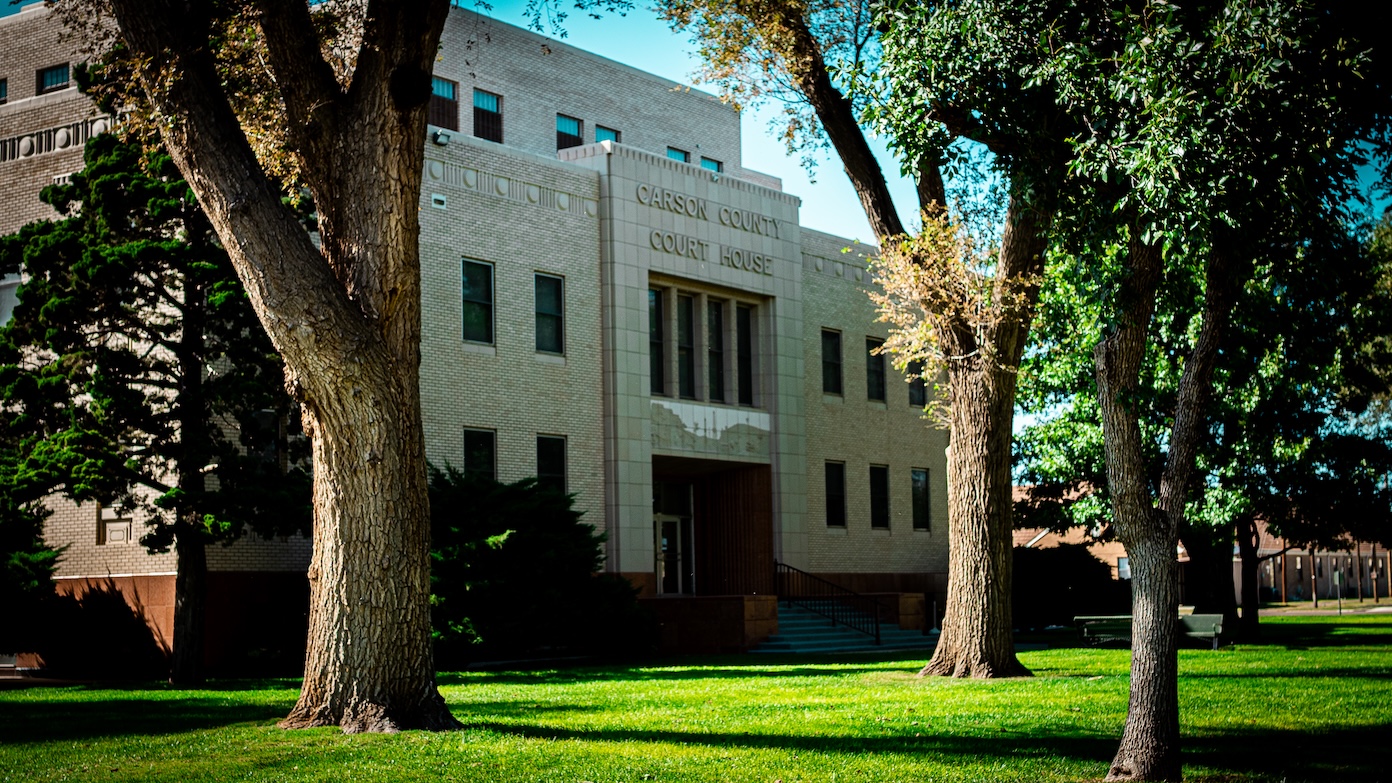
The present courthouse is the third in Carson County’s history. It was constructed in 1949-50 in a modern style, using primarily white concrete, with a striking red brick accent in the lower portion of the building. The Courthouse sits on probably the lushest plot of land in this water-starved county, with decent but not overwhelming shade. The Courthouse’s clean, simple lines match the town’s aesthetic well. There is no courthouse square. Instead, the structure sits on the west side of the main street running through town.
On a Sunday afternoon, all was quiet. It may not be much louder during the week. That was not always the case, pardon the pun. The original 1986 courthouse had a dance hall and cowboy living quarters on the third floor. The dance floor saw enough use to require bi-annual replacements. The arrangement reportedly ensured enough jurors were always available to conduct judicial business.
Things To See And Do
The Groom Cross is a tourist attraction, but an impressive one. Stations of the cross sculptures surround the main cross. Attractions and other sculptures depict the empty tomb, the Shroud of Turin, St. Michael trampling Satan, and a climbable Calvary Hill. If not for the immense scale of the cross, the sculptures would be marvelous as a primary attraction. Inevitably, in the spirit of Route 66, it all leads to a gift shop. A bit campy, but at almost 20 stories high and over 2.5 million pounds, the Cross is majestic. A religious millionaire built it for evangelical purposes and picked a perfect spot. Because of the absolutely level terrain, absence of trees, and straightness of the highway, you can see it for miles in any direction. It stays with you.
That land was donated by a local eccentric who erected his own oddity—the leaning water tower. While not as renowned as its neighbor, Texas Ten liked the wry humor behind the effort. Not to be outdone, the town of Conway (population 20) countered with the Slug Bug Ranch. Once a counterpoint to Amarillo’s more famous Cadillac Ranch, the partially buried VW Bugs failed to save the convenience store and gas station they promoted. But they lived on as a tourist stop; the abandoned building surrounding them seemed a fitting touch.
In 2023, the bugs were removed due to some weird family dispute. A third set of eccentric millionaires, the owners of Amarillo’s Big Texan Steakhouse, came to the rescue, kind of. They acquired the cars and are replanting them at the Big Texan RV Ranch, a successful business in Amarillo. Thus, they are no longer in Carson County. From our perspective, the attraction lost its authenticity, but we guess the result is preferable to the bugs just disappearing. But Texas Ten is glad it stopped when it did and snapped pictures of the original.
Given all that, the two six-shooters made out of barbeque grills adorning a driveway just outside Panhandle seemed almost normal. In downtown Panhandle, the music hall is excellent, the drug store is a time capsule from the late 1950s and early 1960s with an original soda fountain still there, City Hall is in a restored train depot, and the Panhandle Inn begs for restoration. Texas Ten was particularly taken with the Inn, once a grand hotel. The Square House Museum is a window into how people have lived in Panhandle for over a century.
All of those are things to see. For things to do, the local headliner is waterfowl hunting, an odd choice for the perpetually drought-stricken area. The Panhandle, and therefore Carson County, is part of the migratory flyway for various species. Check out the guides section of Potter County (Amarillo) to find hunts or guides close to you when you are in Carson County.
Food, Drinks, And Music (Eat Local!)
Though relatively limited, Panhandle does offer some good eats. Check out Brickstreet 200, a bar and restaurant that offers a little bit of everything – from burgers and po’ boys to steaks and seafood. Pizza lovers will have something to look forward to with Panther Pizza, located one building over from Brickstreet. Fusion concepts have made their way to the range land at Euro Thai Grill, a food truck with seating specializing in a combination of “Balkan European” and Thai. If Euro Thai were an Austin food truck, food bloggers would undoubtedly describe it as “wildly inventive” or a “redefinition of what food is possible.” Finally, located in an unassuming brick building on W. 3rd Street, Downtown Home Cooking, LLC offers takeout casseroles, sandwich spreads, seasonal soups, and cakes, pies, and cookies for those with a sweet tooth.
Panhandle is a bit removed from I-40, so if you are cruising through with only time to stop and see the cross, Groom also has restaurants. The Grill is in town, just a mile off the highway, for comfort food and good conversation about everything happening in Groom. The Den on Route 66 is “elevated convenience store” cuisine at a highway exit. We use that phrase with the reminder that celebrity chef Anthony Bourdain marveled at Texas’s gas station tacos. It is a compliment, not a joke. Continuing Carson County’s tradition of offering world food, The Star Indian Restaurant, also on I-40, serves Indian.
If you want to eat while traveling State Highway 60 between Pampa and Amarillo, White Deer has two tremendous choices: Harrah’s Bar & Grille (a specialty cafe with a nice patio) and El Rincon Cafe (breakfast, burgers, and burritos).
Where To Drop A Dime (Shop Local!)
Carson County is not a retail mecca. The Groom Cross inspires many and offers remembrances and gifts at their gift shop. Sandra Ann’s on the main street of Groom is a quality boutique. But the Pink Dahlia in downtown Panhandle is worth your time. We have seen innumerable downtown boutiques, most of which are fine but sort of run together. Dahlia has that certain something that makes you feel a bit more cutting edge. The architecture exists, there is a lot of traffic on I-40, and Amarillo is nearby. Maybe the store and the Music Hall may foreshadow a renaissance for this charming town. The architecture, traffic patterns, and access to a larger city make it possible. So when you see an article about the “New Marfa,” you read it here first.
Special Places To Lay Your Head (Stay Local!)
Motor courts on Route 66 are Americana to the core. Sadly, only the signs exist now. Until someone refurbishes the Panhandle Inn, you may want to spend the night in Amarillo.
For The Professional Traveller (Campgrounds and RV Parks)
Special Events
Panhandle celebrates Museum Day each September as the county’s big event.
Fore! (Golf Courses)
Panhandle Country Club is a semi-private 9-hole course with alternating tees for an 18-hole experience. The course is flat (not surprising), has limited water hazards (mildly surprising), and is tight (really surprising). Like many things in the region, difficulty depends on the wind.
Panhandle Country Club
100 Maple St.
Panhandle, TX 79068
(806) 537-3300
Getting To Carson County
Way up North, Carson County is dangerously close to Oklahoma and New Mexico. On the east-west axis, it is in the dead center of the Panhandle. From a North-South perspective, it is the third county south of the Oklahoma state line. The major roads are I-40, through the southern part of the county, and State Highway 60, which bisects the county on a roughly diagonal basis from Pampa to the northeast to Amarillo in the southwest. As the county seat, Panhandle is on State Highway 60 and 10 miles north of I-40 via State Highway 207. That means Panhandle is five hours and 40 minutes in drivetime northwest of the state’s geographic center in Brady. Windshield time from other Texas cities can be found here.
Amarillo’s airport is close by (a 30-minute drive from the west) and will work if you can fly American, United, or Southwest. Other major carriers are not feasible unless you enjoy three-hour-plus car drives after landing. The right smaller craft can land in Panhandle at the local airport or next door at Eagles Aerodrome. In the surrounding area, Tradewind Airport in Amarillo, Hutchinson County Airport in Borger, or the Clarendon Municipal Airport.
History
The name Panhandle rightfully evokes images of the Dust Bowl West, which we imagine as desert-like in temperature and without water. To understand the area’s history, we have to start by recognizing our misperception. To begin with, it is a plain, not a desert. Carson County is generally at an elevation of 3,000 feet above sea level, so while there are some scorchers, the heat is not the omnipresent problem we imagine. Next, there is an enormous amount of water. The water just happens to be underground in the massive Ogallala Aquifer.
The climate and natural resources are much better for living and growing things than we assume, as long as humans respect what they have. The struggle to understand and respect the land is the story of the Panhandle region, from Native Americans to oil booms and the Dust Bowl to today.
The area now known as Carson County has been inhabited since prehistoric times. Early farmers and hunters, displaying remarkable resilience, lived here for centuries. Apache Indians of the Plains followed, only to be later moved out by the Comanche hunters and warriors who ruled the Texas Panhandle until the 1870s.
Our records of early European excursions into the area are imprecise, so we do not know the exact routes of the explorers. In the mid-1500s, Francisco Cornado and later Juan de Oñate in the 1600s were in the vicinity. We are sure, however, that the entire region was buffalo grounds controlled by the Comanche until buffalo hunters began the near extinction of the species. The completion of railroad lines into the plains made the shipment of hides to the east and from there to the rest of the world possible. American buffalo hunting parties arrived, decimating the herds that had sustained the resident Comanches for generations. This event, coupled with the ensuing Indian wars, including the final Red River War in 1874, led to the extermination of the remaining great buffalo herds and the removal of Comanches to ‘Indian Territories’ designated by the U.S. government.
Once “cleared,” ranchers began moving to the area. By 1876, the County was officially established and named after Samuel P. Carson, the first secretary of state for the Republic of Texas. Carson was a planter, lawmaker, signer of the Texas Declaration of Independence, and friend of Davey Crockett.
Legendary ranchers established immense operations like the JA and Turkey Track in the 1880s, and cattle herds soon took over the lands grazed where buffalo once roamed. By 1886, the Southern Kansas Railway had stretched through Carson County into the only town known as Panhandle City, marking a significant leap in the County’s development. Despite the residents’ hopes of a second line soon being built to meet in Panhandle City, the Fort Worth and Denver City line missed by 14 miles south of town. It would not be until 1888 that a connector line found Panhandle City, now known as Panhandle, and the city became the county seat.
Windmills soon pumped water to the homesteads of Carson County. Farming and ranching continued to grow, and the railroad extension encouraged development in the area. European and Anglo-American farmers moved into the area, accelerating the region’s agribusiness. Unfortunately, a lack of soil conservation techniques would exact a terrible price within a decade as the vegetation that held the dirt down vanished in the name of quick bumper crops.
Separately, Experimental drilling by Gulf Oil in 1920 led to the area’s first oil and gas production, which led to even more oil exploration, the building of the first oil refinery, and an eventual oil boom in the 1930s.
Though the population had grown steadily in the early part of the 1900s, farming dropped off during the Depression and the Dust Bowl years. By World War II, the economy started to recover, and defense spending for the Pantex Ordnance Plant in 1942 bolstered the area’s fortunes.. Throughout the years, depending upon the necessary armaments, the plant went from bomb and artillery shell production to nuclear weapons assembly in the 1980s.
Carson County’s economy remains diverse today, ranging from ranching and farming to oil production and government employment at Pantex. Though the county favored Democratic candidates through the 1950s, a shift in recent times has turned it deep red.
According to the 2020 census, Carson County’s population is 5807. The county’s ethnic makeup is approximately 83% Caucasian and non-Hispanic, almost 9% Hispanic/Latino, 2% of two or more races, 2% Native American, with the remaining 4% spread among other groups or not identified. Over 93% of age-eligible residents graduated from high school, and 25.2% of the population holds a bachelor’s degree or higher. The high-school graduation rate is higher than state and national statistics, while the college graduation rate is slightly below these averages. The median household income in Carson County exceeds state and national averages by about 10%, with significantly fewer families living below the poverty line.
Carson County has been home to notable individuals such as NFL player Joe Ethridge and punter Kevin Brown, Pro Golfer Steve Haskins, and bounty hunter Leland Blane Chapman.
Primary Sources:
Texas State Historical Society
OTHER: GROOM (LEANING TOWER OF BRITTEN)