


Field Guides
Pittsburg, Texas
(Camp COUNTY)
Pine forests, peaceful lakes, and a warm East Texas welcome in every smile.
Highlights
Camp County is known for producing things you fry. One of Texas’s smallest counties lays claim to one of Texas’s biggest personalities, Charles “Bo” Pilgrim. There is more about Bo in our section on Camp County history, but Bo gave us Pilgrim’s Pride Chicken, and Texans have fired “a mess of it” over the years. The county is home ot some of Texas’s best fishing, notably Lake Bob Sandlin. Plenty of those have been fried also. More recently, the food we love Camp County for is the Pittsburg Hot Link, made famous in the county seat of Pittsburg.
Downtown Pittsburg has more than the hot links and is an enjoyable stop. In particular, the never-closed Prayer Tower is an interesting and inspiring building. In addition, there is a tale and example of aviation history. Beyond that, it is time to fish.
The County Courthouse
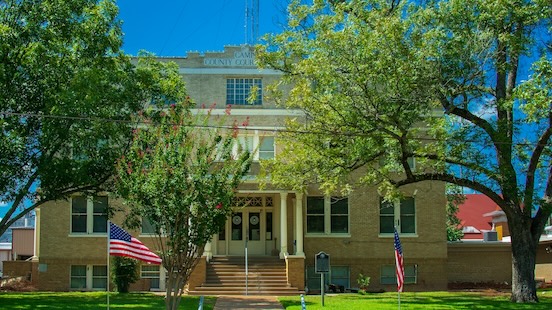
The Camp County courthouse is a simple structure in the classic revival style, which is to say a large building that would look at home in ancient Greece or Rome. This structure, built in 1928 as the county’s second courthouse, fits the bill. Texas Ten likes symmetry and a spacious green surrounding the courthouse, without too many trees obstructing the view of the county’s most important building. Camp County delivers on that score. Texas Ten also likes for the Courthouse to occupy the middle of the county’s square, which Camp County does not do.
Instead, the building sits at the end of and slightly off-center from one of the main thoroughfares. That criticism is not much of one; overall, the building looks like a courthouse should.
Things To See And Do
Pittsburg and the surrounding area will never top Texas’s tourism list, but plenty of natural beauty exists if you want to relax. Lake Bob Sandlin is the star. Camp County shares the lake with Titus County, but the state park headquarters are on the Camp County side of the lake, so we talk about it here. East Texas is known for its trees, and they surround the lake. The trees get some color in the fall and provide a beautiful backdrop. At 9,000 acres, the lake is a manageable size where you will unlikely lose your way home.
The bass, in particular, draws anglers. Largemouth, white, and spotted bass are all present in legal sizes. Catfish, crappie, and sunfish will hit your line, too. For more fun, there is a rainbow trout stocking program. The bulk of the state park is on the Titus County (North) side with campsites for RVs, tents, screened shelters, and a group facility. There are trails and piers—everything you need for a fishing weekend. Better yet, there are many lakes of similar quality in the neighboring counties–Cypress Lake, Monticello Lake, Welsh Lake, and Lake of the Pines.
We mentioned that the trees can give color in the fall. Portions of the Texas Forest Trail come through Camp County along State Highway 11 and Farm to Market Roads 557 and 21. Mid-October through mid-November offers high-quality hiking and photography opportunities. With a bit of luck, you will stumble on a roadside stand offering locally grown peaches, berries, or melons. If you love the outdoors in a really relaxed, I like to be comfortable way, there are two wineries (see the Eat Local Section) to check out.
Downtown Pittsburg also has sites to see. Start at the Northeast Texas Rural Heritage Museum, located in a former Texas & St. Louis Railroad train depot. It is open from 10:00 a.m. to 4:00 p.m. and is only open Thursday through Saturday, so you want to plan your visit accordingly. Inside is a replica of the Ezekial Airship, which allegedly predated the Wright brothers in manned flight. We will leave the story for you to discover, but it is worth your time.
When walking Main Street, be sure to find the Coca-Cola mural. It is hard to miss, as it is the largest in Texas. Then, it is over to the nearby Prayer Tower, which is a gift from Bo Pilgrim to the city. The structure is 75 feet tall and has four bells from France that play hymns on the hour. The park around it contains a small reflecting pool and a stunning sculpture of Christ washing the feet of a servant. The stained glass in the chapel is breathtaking. But most of all, the stillness surrounding you as you take it in is precious. The chapel never closes, always ready to give respite, solace, or joy. Whatever is needed.
Pittsburg and Camp County do not have many other tourist attractions, and we don’t think they need them.
Food, Drinks, And Music (Eat Local!)
A chicken from Bo Pilgrim or a bass from Lake Bob Sandlin is great. But let’s face it, they are white meat. If you came to Pittsburg to eat, you probably went for the beef. More specifically, for the 100% beef known as the “Pittsburg Hot Link,” served at the Pittsburg Hot Link Restaurant. The links are delicious and particular to this part of the world (although they can be shipped straight to you). Next to the melt-in-your-mouth, spiced-for-flavor-but-not-extreme-heat taste, what we like about the links is the back story.
There are many iconic family restaurants in Texas, and we love them. A family owns Pittsburg Links, but it is really an iconic community eatery. German immigrants brought the link to the area at the turn of the 20th century; there were many purveyors of the link at one time. The current restaurant resulted from consolidating the town’s best and paying homage to them. Pittsburg Links are a culinary must for any Texas traveler, not only for the taste but also for the heritage.
There is a “date night” spot in Pittsburg at the Los Pinos Ranch Vineyard. The food is good, the wine better, and the scenery unbeatable. Los Pinos now has company in the vineyard business in the form of Un Sueno Vineyard and Zepeda Vineyard & Winery. Un Sueno has small plates to go with the wine, but is less of a whole dinner place. Zepeda is a small winery that does not have a restaurant, but does have interesting offerings.
Racks, Daqz, and Axe features serious barbecue next to a drive-through daiquiri location and an axe-throwing bar. Ingredients for a fun night, but let’s ensure no one is overserved with an axe in their hand. Vaughan’s Catfish On the Lake and Castaways Bar & Grill at Big Al’s Barefoot Bay do not need more explanation, but they are, in fact, lakeside bar and grills with occasional music. We are unsure if Steve-O’s 1981 Bar & Grill in downtown is more of a “bar” or a “grill,” but the food is good, the drinks are well-made, and there are fun events.
The rest of the local restaurants in Camp County fit mostly into two categories: either a general American cafe or Tex-Mex. On the old-fashioned home-cooked meal side, we have Madeline’s Cafe, Herschel’s Restaurant, LalaPop’s Ice Cream, Coffee, and Cafe, Candie’s Crossties, and Ma’s Cafe of nearby Leesburg. In a subset of the home cooking Venn diagram, there is Scoops Chicken Salad Market, which specializes in, let’s see, we think maybe … chicken salad. Oasis is a bait shop restaurant. It is more critical for a bait shop to have good food for the fish than for the fisherman, but we are sure the folks at Oasis give good effort to both groups of diners.
For enchiladas, tacos, tamales, and the like, your options include Papa Nacho’s, Peraltas Mexican Restaurant, Daysi’s Taqueria y Mariscos, and Taqueria Las 3 Monedas.
The nightlife is not very wild. Generally, background sound at Racks, Vaughns, Castaways, and Steve-O’s is the music scene.
Where To Drop A Dime (Shop Local!)
Pittsburg is not an all-afternoon, browse-and-come-back shopping destination. With that out of the way, you can treasure hunt at Rick’s Antiques Safari, Southern Sisters’ Junktion, and All Occassions Antiques for vintage; or The Mayben Group, Chicks ETX Boutique, A Gypsy’s Clothesline for ladies’ clothing; and Rustville Essentials for thoughtful gifts. All Occasions, The Mayben Group, and Rustvile Essentials are downtown. The others are minutes away.
Special Places To Lay Your Head (Stay Local!)
The Carson House is a lovely bed and breakfast in a historic home. Lavender Memraid B & B is a group of cottages in an idyllic setting. Anna Bella’s Lakefront is a quaint cottage that comes with the use of a boat. Big Al’s Barefoot Bay also has lakefront cottages for rent.
For The Professional Traveller (Campgrounds and RV Parks)
Special Events
Pittsburg lens into what makes it famous with the Hot Link Festival every April. Hot Link to your heart’s content. The Rodeo is in May, and Pioneer Days, celebrating the area’s heritage, is in September. Beyond that, the green is in full force in the spring, and the colors are vibrant in the fall, usually in late October.
Fore! (Golf Courses)
Princedale Golf Course utilizes the area’s lush natural beauty to full effect. A challenging nine-hole affair will give you plenty to think about. One of the better short courses in the state.
Hwy 11 E
Pittsburg, TX 75686
(903) 856-3737
Getting To Camp County
Camp County is well into the northeastern corner of Texas, but not quite to either the Louisiana or Oklahoma border. Pittsburg is at the intersection of State Highway 271, running roughly north/south, and State Highway 11, running east/west. Interstate 30 is about 14 miles north of Pittsburg via Highway 271. That means Pittsburg is about five hours and 30 minutes east, northeast of the state’s geographic center in Brady. Windshield time from other Texas cities can be found here.
It is not easy to fly with major carriers to arrive in Camp County. American serves the regional airports at Tyler and Texarkana. Tyler is slightly closer, but both are between an hour and an hour and 15 minutes away. Shreveport’s airport is about an hour and a half away, but adds flights from Allegiant, Delta, and United to service by American. The closest large airports are Dallas Love Field and DFW International. Both are two hours and 15 minutes to the east on a good traffic day in Dallas. Love handles Alaska Air, Delta, and Southwest, while DFW has every major carrier except Southwest. Smaller craft can choose from Richardson Field, Glover Airport, and Mt. Pleasant Regional Airport-KOSA, each within 15 minutes of downtown Pittsburg. If not, East Texas Regional Airport, Cox Field-Prx, Sulphur Springs Municipal Airport (KSLR), Mineola Wisener Field-3F9, and Harrison County Airport are all under an hour away by car.
History
The area now known as Camp County has been occupied on and off for thousands of years. Archaeological evidence shows that early Caddoan culture occupied the region with its highly developed agricultural society. Between the 1820s and 1830s, the Choctaw, Cherokee, and Creek had also settled here but had all but been displaced by Anglo settlers by the 1840s.
European Exploration of this area began in the 1500s with early Spanish expeditions led by Luis de Moscoso, who, after Hernando de Soto died exploring the areas of Louisiana and Florida, ventured into Texas, hoping to find gold. The French came to the area in the early 1700s and established a fort named Le Poste des Cadodaquious, occupying this for some fifty years before abandoning it to explore farther southwest.
In the 1830s, settlers from the southeastern United States began moving into Texas, bringing a Southern farming culture that included slaveholding. The earliest town formed was Pittsburg in 1850, which by 1860 had become a crucial supply hub for the area’s farmers. In 1874, Camp County separated from Upshur County and was named for the state senator, John Lafayette Camp, from Upshur County. That same year, Pittsburg was chosen the county seat by election and has remained ever since.
The ratio of blacks to whites remained nearly even through the 1800s. Though the Civil War had little effect on this area, Reconstruction allowed the Republican Party and the Black vote to be heard. By 1876, however, Democrats regained control and remained the dominant party in Camp County for over a century.
The Texas and St. Louis Railway, a significant historical landmark, arrived in 1870 and intersects the county in Pittsburg. This railway played a crucial role in the development and connectivity of the region, shaping its history and economy. Cotton was the principal cash crop and provided most of the economy to the County until the Great Depression. During this period, many farms would have failed if not for the relief provided by the Agricultural Adjustment Administration. Despite this aid, the population fell, the cotton culture ended, and the economy declined. In the 1940s, farmers were paid to remove cotton from their land and forced off, creating an effect of desertification. However, oil was also discovered, serving as an incomplete replacement for the loss in the agricultural economy. By World War II, mechanization and an emphasis on livestock production supplanted agriculture and oil as the primary economic drivers in Camp County.
While there are multiple types of light industry, poultry processing became the most significant employer, thanks primarily to Pilgrim Industries. Lonnie “Bo” Pilgrim was born in the small Camp County town of Pine. After a poverty-stricken and rocky childhood and an early religious conversion, Pilgrim opened an agricultural supply and feed store in Pittsburgh with one of his brothers. The chickens were originally given away to customers, but as Pilgrim began to understand their value, he transformed it into a loan program. By the early 1960s, Pilgrim and his company, Pilgrim’s Pride, were in the poultry production business.
While religious and philanthropic, Bo Pilgrim was also shrewd and ambitious. He desperately wanted Pilgrim’s Pride to be the country’s largest chicken meat producer, and he fought for decades to overcome Tyson’s Foods for that honor. A not insignificant reason for the growth was Pilgrim Pride’s marketing efforts, starring Bo Pilgrim. Pilgrim’s catch phrase was a promise not to sell a “fat, yellow chicken.” The purchase of competitors also fueled the company’s growth.
Pilgrim achieved his long-time goal in 2006. For once, however, his timing was his worst enemy. The demand for chicken fell drastically in the years following Pilgrim’s acquisition spree, and the company sought bankruptcy protection in 2008. The new owners moved the company’s headquarters from East Texas to Colorado.
Pilgrim was a controversial figure. He once handed out $10,000 blank checks to state Senators on the Senate floor to influence a workers’ compensation bill. He encouraged migration from Mexico so he could field a workforce. There were many environmental concerns at his plants. Ultimately, however, Pilgrim’s ambition, marketing prowess, and philanthropy left the lasting impression of Camp County’s most famous citizen.
According to the 2020 Census, Camp County’s population of 12,464 is 58.85% Anglo, non-Hispanic, 21.35% Hispanic or Latino, and 17.20% Black. The remaining percentage comprises Asians, Native Americans, or those of two or more races. The county is now deep red politically. While the county has an average number of high school graduates, it falls behind the rest of Texas and the United States in college graduation rates. There is more poverty and lower average income in Camp County compared to state and national averages, but not to the extent of blighted towns or communities.
In addition to Bo Pilgrim, Camp County is home to several accomplished individuals. Notable figures include Carroll Shelby, an automotive designer known for the AC Cobra and Mustang; Mezzo-soprano opera singer Barbara Smith Conrad; football wide receivers Kendall Wright and Homer Jones; American singer Jim Gilstrap; and Mildred Fay Jefferson, the first black female to graduate from Harvard Medical School.
Primary Sources: