


Field Guides
Silverton, Texas
(Briscoe COUNTY)
Red canyons whisper of cowboys, dust, and endless Texas sky.
Highlights
Briscoe County is probably the geographic center of the Panhandle, which is appropriate because the county is an almost perfect representation of the region. Sparsely populated, tied to livestock, and with a history of pioneer ranchers who wrestled small empires out of uncertainty, the county tells quite a story. But nowhere is that story more evident than the land itself.
The image many have of the Panhandle links directly to the dust bowl. Flat, brown, and still uncertain. For the record, Texas Ten once had that impression also. Our visit to Briscoe County disabused us of that notion through a spectacular spring day hiking Caprock Canyon State Park. A caprock is a hard top over a more malleable underneath. Over eons the the clash of the irresistible and the immovable transformed prairies into dramtic landscapes with red rock backed by brilliant blue skies. The Panhandle landscape provides constant surprises and the absolute best place to see it is Caprock Canyon.
At the 2020 census, there were less than 1,500 people living in Briscoe County, spread between the completely rural and the two small communities of Silverton and Quitaque. There are no populous counties close to Briscoe. Those two quaint towns are great, but probably not a reason to detour an hour and a half from Amarillo. Caprock Canyon is beyond worth the trip.
The County Courthouse
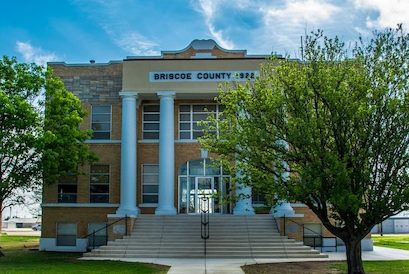
The Briscoe County Courthouse is a stately 1922 classic revival model, last restored in 1957. The courthouse sits in the middle of the square, as a courthouse should. Also on the property is the original rock jail and a modern, well-executed veterans’ memorial tribute. For a rural county with a small population, the courthouse is quite impressive.
Things To See And Do
Caprock Canyon State Park is the county’s raison d’etre. There is great hiking, great mountain biking, great horseback riding for people who know what they are doing, great scenic drives, great camping, and great chilling by the lake. Generally great in other words.
It should come as no surprise that such a great park has an impressive historic lineage. Charles Goodnight is among the greatest Texans to ever live; he and his partner Oliver Loving were the loose models for Captain Woodrow Call and Gus McCrae in Lonesome Dove, Larry McMurtry’s novel that most defines 19th century post-revolution Texas. Goodnight and Loving pioneered the long cattle drive; Goodnight in particular seemed to be involved in every significant Texas event for a run of 40-50 years.
One of Goodnight’s great achievements was to establish and maintain the enormous JA Ranch, named for the primary financial backer, Irishman John Adair. The Caprock Canyon State Park land was part of the JA Ranch, donated to the state by eventual owner Theodore Geisler. The land is spectacular but the donation came with something else.
Bison once ruled the plains around Caprock and throughout the Panhandle. Millions of them. The great tribes of Native American horsemen depended on the bison for their way of life, the animal was as essential to their way of life as energy is to ours. In the late 1800’s, westward expansion/manifest destiny collided with ancient tradition in this exact spot. Killing the bison accomplished two things. First, it wrecked the economy of the Native Americans, rendering unfeasible the natives’ hold on land that settlers coveted. Second, the fur pelts of the bison were extremely valuable for making apparel. Thus, what has become known as the Great Slaughter, reduced the millions of bison to a species on the razor’s edge of extinction.
Enter Charles Goodnight and his wife Mary. The Goodnights feared for the survival of the bison, so Charles-at Mary’s urging-adopted a small herd of 200 animals. Several other area ranchers did the same. The “Goodnight Herd” lived on at the JA Ranch after the Goodnights passed. The animals were just there though-protected but not remarked on. By 1994, the stock had dwindled to 50.
Wolfgang Frey, an enterprising conservationist, heard about the JA Ranch bison and tested the animals. Frey found a genetic marker proving these remnants of the Goodnight Herd on the JA were direct descendants of the marvelous beasts that once defined the area. The JA Ranch donated the herd to the State, who moved them to Caprock Canyon State Park where they now roam freely as the “Official Bison Herd of Texas.”
The animals are magnificent. They were also calm while Texas Ten was there, for which we are eternally grateful. We felt extremely close to Texas history on that day.
Charles Goodnight, Cowman and Plainsman by J. Evetts Haley is a tremendous read about this legendary Texan. Texas ten recommends it whole-hearedly fi you want to understand the area. For more detail on local history while there, the Comanchero Canyons Museum in next-door Quitaque is an excellent resource and can be covered in a few hours.
Outside of the park and history, there is Lake MacKenzie, a man-made reservoir that supplies water to Silverton and three other cities in adjacent counties. The lake is scenic but is battling low water levels at present. Hunting opportunities for a variety of deer, quail, hog, and turkey exist but only through leases, which can be hard to come by. For a better sense of the hunting possibilities, you might want to check out Tule Creek Outfitters in Tulia, one county to the west.
Likewise, Quitaque is almost on the border of Hall and Floyd counties, so checking out the activities there is well worthwhile. In particular Pole Canyon Ranch has its official address in Quitaque but is actually located in Floyd County. Regardless, it is very close and it is one of, if not the, premier adventure spots in Texas. When in the area, Pole Canyon is definitely a place to check out.
Food, Drinks, And Music (Eat Local!)
Casual home cooking is what you will get from the few restaurants in the area. In Quitaque there is the Bison Cafe and Coffee Mill & Mercantile. In Silverton, you can try Sabrina’s Cafe, the Malt Shop, Night Owl Espresso, or the Briscoe Bite (food truck at the Silver Wind RV Resort).
Where To Drop A Dime (Shop Local!)
In Quitaque it is Karol’s Kountry Korner, the Beyond Blessed Boutique, and the Quitaque Trading Post for unique items. In Silverton, the Night Owl may have some unique items, other than that it is best to check out the surrounding area.
Special Places To Lay Your Head (Stay Local!)
Shepherd Family Cabins offers four unique short-term rentals; SIlver Wind RV also has several cabins. Other than that, there is not much in the way of charming hotels or short-term rentals in Briscoe County, although the Hotel Turkey is just across the county line in Turkey. Other than the RV sites in Briscoe County, if you are going to be in the area it is probably best to check out accommodations in nearby Hall, Floyd and Motley counties.
For The Professional Traveller (Campgrounds and RV Parks)
If you are visiting the park, why not stay there? The State Park service has sites with electricity and primitive camping sites for you. The same for Lake MacKenzie. For more amenities there is Silver Wind and Shepard Family parks. Once again, check out Hall, Floyd, and Motley counties for more options.
Special Events
The main event in Briscoe County is the fair, rodeo, and county celebration in early August each year. Nearby Turkey In Hall County is a hotbed of activity as is the Pole Canyon Ranch just to the south in Floyd County.
Fore! (Golf Courses)
Nope. Nowhere close.
Getting To Briscoe County
Silverton sits about in the middle of the panhandle, at the intersection of SH 86 running east/west, and SH 62 running north/south. Amarillos is about sixty miles to the northwest, Lubbock is about 80 miles to the southwest. The nearest interstate is I-27 running north and south through Tulia, 27 miles west of Silverton. In the big picture, Silverton is four hours and 50 minutes to the northwest driving from the geographic center of the state in Brady, Texas. Windshield time from major Texas cities can be seen here.
Flying to the area via a major carrier means either Amarillo or Lubbock. The same airlines serve both-American, United, and Southwest. Silverton has a municipal airport. If that does not work, smaller craft can try the airports in Plainview, Floydada, Childress, or Clarendon, each 40-50 miles away.
History
The evidence indicates that the area was inhabited by pre-Columbian people who had built highly civilized existence and irrigation canals. In the 1700s, Plains Apaches and later nomadic Comanche hunters came to live in these high plains and canyons. By the late 1700s, trade expedition parties set out to explore this area, which Comanchero traders frequented. These traders were named after the Comanches, their best customers. When settlements began in the late 1800s, white settlers were frequently raided by neighboring Comanches.
In the past, horses and cattle were stolen and traded with visiting Comancheros for items such as tobacco, coffee, and whiskey. Additionally, white captives were kidnapped and traded to other Native groups. Legend has it that there is a valley west of the Quitaque Peaks known as the Valley of the Tears, where mothers and children who were kidnapped and separated from their families cried out in despair. It is believed that their anguished cries can still be heard echoing through the hills.
The town of Quitaque became a stagecoach stop in the 1890s, and settlers began to arrive.
Briscoe County was officially organized in 1897 and named for Andrew Briscoe, a signer of the Texas Declaration of Independence, soldier in the Texas Revolution, merchant, and judge. Silverton was chosen as the county seat, and by 1900, the population had increased enough to have six school districts, primarily made up of children of immigrant farmers.
Wheat and sorghum were grown in the region, but cotton was grown first as an experiment and later became the county’s most imported cash crop, bringing the first gin in 1912. Until 1925, crops were traded by mule train and freight wagons, but agricultural growth brought the expansion of railways, and the Fort Worth and Denver Railway decided to expand into this area. Soon, roads were added, and State Highway 256 was completed.
Agriculture suffered during the Great Depression, and in 1940, cotton production dropped by more than 30%. Population losses were also felt, and the numbers continued to fall through WWII. Eventually, ranching overtook farming, making up 66% of the economic revenue in the area.
Voters in Briscoe County favored Democratic candidates from 1892 to 1968, with an occasional Republican taking over the majority. 1972, Republican candidates began to receive the majority, except Jimmy Carter in 1976 and Bill Clinton in 1992.
According to the 2020 census, Briscoe County’s population is 1,435, with 15.7% holding a bachelor’s degree or higher. The median income here is $35, 446 with a 46% employment rate.
The ethnic breakdown of the county is made up of 82% White, 10% Hispanic, and 8% Black or more than two races.
Notable people who call Briscoe County home are American composer Raie Britain, Economist and Writer J. Orlin Grabbe, American Football Coach Gene Mayfield, and Basketball Coach Harley Redin.
Primary Sources:
Texas State Historical Society
Famous People of Briscoe County
OTHER: QUITAQUE