


Field Guides
Claude, Texas
(Armstrong COUNTY)
Sweeping Panhandle vistas with dramatic Palo Duro Canyon views.

Highlights
Claude, Texas, in Armstrong County, is one of those towns that many travelers see as a milestone. If you drive west on State Highway 287, the Claude city sign means you are getting close to Amarillo. Conversely, driving the other way means you have left Amarillo and are set for the open road for quite a stretch.
But Claude and the surrounding area tell us quite a bit about Texas based on events centuries apart. The creator of the Texas cattle economy and one of the most remarkable Texans ever, Charles Goodnight, made Armstrong County his base of operations. When oil threatened to change the way of life for the cattlemen, we learned about how passionate people could be on the subject from a movie filmed in Claude starring the biggest of the big screen stars-Paul Newman, along with Patricia Neal and Melvyn Douglas in HUD. And that is just part of the area’s movie-making history.
Travelers should plan stops at the Charles Goodnight Historical Center, located in the rancher’s wonderfully preserved home, and the County Historical Museum, which is housed in and around the Gem Theater. Both tell stories important to the state’s history and culture. Both are well above the usual attractions in towns the size of Claude.
In this heartfelt Texas Ten Podcast segment of M’Lissa’s Memories, M’Lissa Howen takes us to The Gem, where she met the unforgettable duo Sylvia and Carl. With warmth and humor, she shares the story of their kindness, charm, and the sense of community they bring to their corner of Texas.
The Armstrong County Courthouse
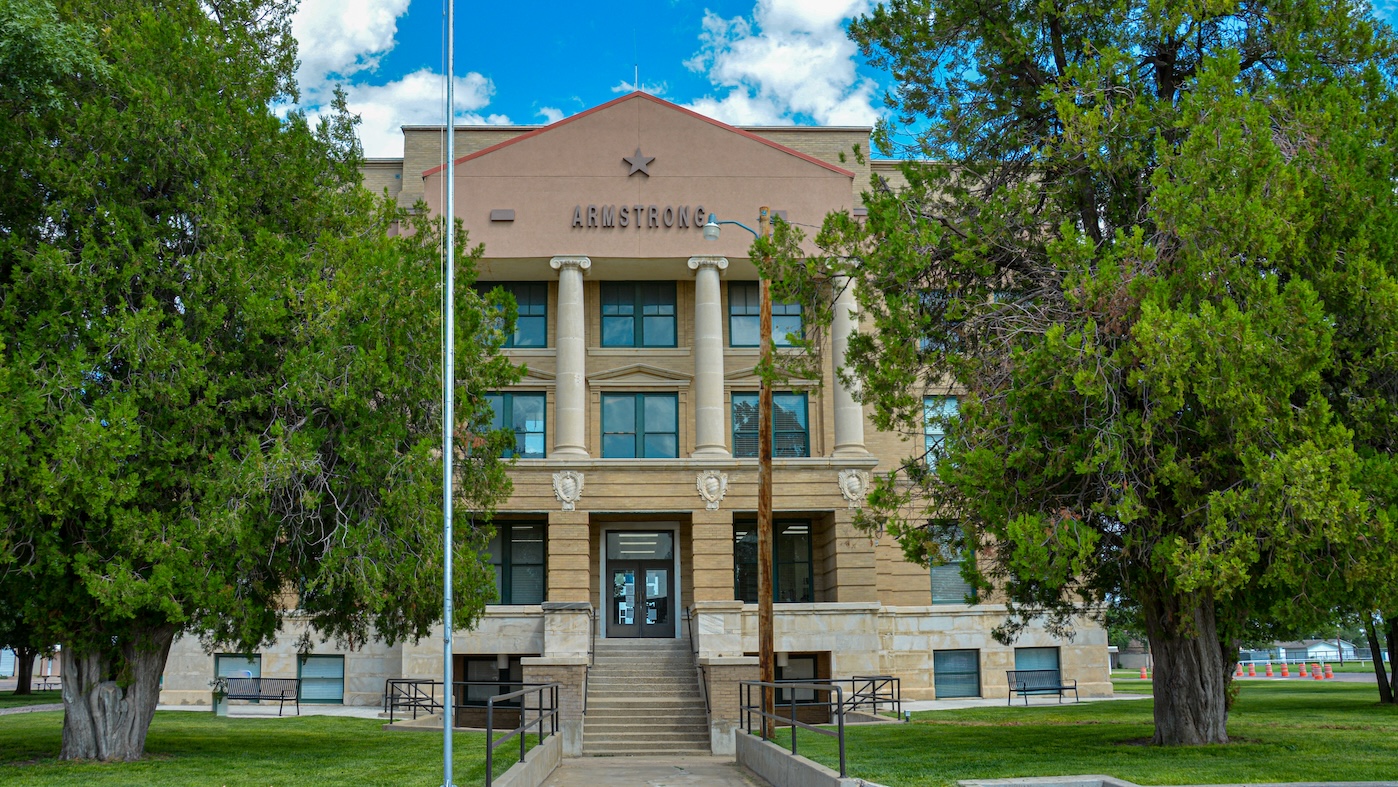
The present courthouse is the second courthouse built in Claude. Not much is known about the first structure other than a written report that the citizens expected at some point it would fall in on judge and jury. The current courthouse is much sturdier., Constructed in 1911 and 1912, using classical revival architecture from Fort Worth’s notable architect Elmer George Withers, the building seems massive for a rural county. Traffic from Hwy 287 whizzes by, so the “hometown feel” is a little bit lost. On the other hand, the courthouse lawn is safe from unnatural trees, and the prairie is visible. The building has a true “Old West” feel, consistent with the County’s history.
Things To See And Do
The State Historical Commission maintains the ranch home of Charles and Mary Goodnight in the nearby town of Goodnight. The site is open to visitors from 10:00 am-5:00 pm Tuesday-Saturday with guided tours at 11:00 am, 1:00 pm, and 3:00 pm. Charles Goodnight is an absolute legend in the cattle industry, and his accomplishments cannot be overstated. He embodied the Texas Spirit and was probably the “Real John Wayne” before there was a John Wayne. As proof of that fact, his story is told in the celebrated TEXAS musical in Palo Duro Canyon and in fictionalized form through the epic Lonesome Dove mini-series, which was based on the cattle drives engineered by Goodnight and his partner Oliver Loving. Mary Goodnight is every bit as interesting.
Their ranch home is gorgeous and immaculately preserved. You cannot understand Texas and cattle unless you know a good bit about the Goodnights. This is a stop worth making.
Almost a century later, the abundance of oil in West Texas changed the landscape again. While “easy riches” can be enticing and are almost never easy, West Texans can be stubborn. Some did not like what the change meant. That transition is the backdrop for the family drama in HUD, based on the Larry McMurtry novel Horseman, Pass By. On a trip to Amarillo, we stopped to visit the town. We ran into a delightful couple just closing up the Gem Theater, which has been converted into the Armstrong County Museum and a venue for live performances. Hud was shot on location in and around Armstrong County, including outdoor scenes at the Goodnight Ranch. Newman prepared for his role by working as a local ranch hand.
Apparently, there was a U.S. celebration of the film, including appearances by acting royalty, at the Gem. The film was successful, winning Oscars for Patricia Neal and Melvyn Douglas. Newman was nominated but did not win. It was a charming story, and we were thankful for the time the museum volunteers spent with us.
Armstrong’s film history does not stop there. Actually, it did not start there, either. Way back in 1916, Colonel Goodnight was among the first to bring the Texas frontier story to the screen in the silent film Old Texas, made in Armstrong County. After the HUD filming, Hollywood returned for the 1977 TV Movie Sunshine Christmas, starring Cliff DeYoung. If you are interested, Sunshine Christmas proves that Hallmark Christmas movies existed long before the Hallmark Channel. The most recent entry into Armstrong County’s Hollywood ledger comes at the end of Indiana Jones and the Last Crusade. When Indy and friends ride triumphantly into the Western sunset, that is Armstrong County again. The County Museum does a great job of detailing this rich history and is a must-stop.
The terrain in Armstrong County is strange. Travelers who do not leave Hwy 287, which slices through the county’s North end, would believe the world is as flat as a pancake. To the South and West, and not easily accessible, lies Palo Duro Canyon. As the nation’s second-largest canyon, the landmark touches several counties. We cover it most in depth in Randall County, but we note that Randall and Armstrong counties share the Palo Duro Canyon State Scenic Park.
Claude is also the headquarters for Merus Adventures, which offers the opportunity to experience Palo Duro Canyon through exhilarating off-road adventures, motorized, hiked, or ridden. The scenery is incomparable, and this is a unique, get-your-heartbeat-up way of seeing it.
There is also good hunting in the area. Deer (mule, white-tail, and pronghorn), fowl (quail, dove, crane, duck, and goose), turkey, and hog are all abundant in season. Hogs are always abundant. Leases can be had, but one needs to be vigilant because they do not last long.
Goodnight Ranch Home
4989 CR 25
Goodnight, TX 79226
(805) 670-5627
Armstrong County Museum
120 Trice St.
Claude, TX 7901(806) 226-2187
Merus Adventures
4510 CR 9
Claude TX 79019
(806) 944-5393
Food, Drinks, and Music (Eat Local!)
For the local flavor, try OJ’s Mexican Restaurant, The Burrow (coffee shop with light eats), or The Red Roof Grill (Cafe):
OJ’s Mexican Restaurant
806 1st St.
Claude, TX 79019
(806) 226-2777
Monday-Friday 7:00 am- 8:00 pm
Saturday 7:00 am-5:00 pm
Sunday 8;00 am-5;00 pm
The Burrow
116 Trice St.
Claude, TX 759019
(806) 477-2872
Closed Sunday-Monday
Tuesday -Saturday 7:00 am-2:00 pm
The Red Roof Grill
102 Parks St.
Claude, TX 79019
(806) 226-2089
Closed Sunday-Monday
Tuesday-Wednesday 11:00 am-2:00 pm
Thursday-Friday 11:00 am-2:00 pm and 5:00 pm-8;00 pm
Saturday 11:00 am-2:00 pm
Where To Drop A Dime (Shop Local!)
You can find a dose of retail therapy at Farm Girl Frosting located at 101 Goodnight St., Claude, TX 759019, (806) 670-4086.
Special Places to Lay Your Head (Stay Local!)
Given its proximity to Amarillo and Canyon, it’s not surprising that Armstrong County has no unique hotels.
For the Professional Traveller (Campgrounds and RV Parks)
Merus is an outdoor adventure park with camping, glamping, cabins, and RV spots.
Special Events
The whole county gathers for the Caprock Roundup Rodeo and Old Settlers Reunion, usually the second week of July.
Fore! (Golf Courses)
Charles Goodnight was never a golfer, and the county followed his lead.
Getting to Armstrong County
Armstrong County is in the north-central portion of the Texas Panhandle, just east-southeast of Amarillo. The county seat is approximately five hours and ten minutes north-northeast of the state’s geographic center in Brady, Texas.
Claude sits on and across State Hwy 287, which runs roughly parallel to Interstate 40. The Amarillo Airport, served by United, American, and Southwest, is 30 minutes away. While Claude does not have a municipal airport, smaller craft can land in Amarillo at the Tradewinds Airport or in Clarendon, which are both 35-40 miles away.
History
Twelve thousand years ago, this locality was home to the Folsom and Clovis Cultures. They hunted mammoth and great bison using flint quarried in what was later named Palo Duro Canyon. In the 1500s, when Francisco Coronado’s expedition came through the region, Coronado named it Palo Duro, Spanish for ” hard wood Juniper trees. By the 1700s, Nomadic Plains Indians, including the Comanche, Kiowa, and Apache, inhabited the land, hunting the great bison herds.. These horsemen held onto their land until 1874, when the Battle of Palo Duro Canyon became their last stand against the United States Army. With thousands of their horses rounded up and killed, the feared warriors reluctantly retreated to the reservations set aside for them across the Red River in Oklahoma.
In 1876 and with the natives cleared out, Ranchers Charles and Mary Ann Goodnight drove more than 1,600 cattle into the area and established the JA Ranch, the largest ranch still in the Texas Panhandle today. When natives returned to the area in the fall of 1878 to hunt, Goodnight reached a treaty with Quanah Parker, the last chief of the Comanches. The natives were promised two beeves (cows) every other day in exchange for not disturbing the herds being driven to Kansas City. Their relationship and mutual respect endured through ongoing written communication. A pioneer of cattle ranching, Goodnight, sometimes referred to as the “Father of the Texas Panhandle,” is also famous for the invention of the Chuckwagon. His wife, Mary Ann, was a casual conservationist who set out to protect the bison calves that were quickly being slaughtered into extinction. These calves’ descendants still roam the region today.
In 1887, the Fort Worth and Denver City Railroad stretched across the county, reaching New Mexico and Colorado. The railroad’s presence encouraged settlers to come, and homesteaders raising stock and crops moved in. The county remained unorganized as an official entity until March of 1890, when it officially incorporated. Claude, named for a railroad executive, became the county seat. Armstrong County was named after one of the original pioneer settlers in this area, but today, history is unclear as to which Armstrong it was.
When first populated, the county was all ranches. Over time, however, many of the ranches divided or downsized. Farmers took over the land, growing primarily wheat and cotton. The Great Depression and the Dust Bowl took their toll, but today there are still cotton farmers, wheat farmers, and ranchers as the foundation for the local economy.
That said, Armstrong County is one of America’s least populated, isolated counties, with a recently reported population of 1,782 people. The population is largely Anglo, with approximately 87% of the county reported as Caucasian, non-Hispanic, and 10% as Hispanic. The County’s educational achievements and median household income fall above state and national marks.
In politics, Armstrong County mirrors the rest of rural Texas. From its inception through 1968, Armstrong was safely within the conservative wing of the Democratic Party. From Nixon until today, the County has increasingly embraced the GOP with almost 93% of the votes cast in 2024 going to President Trump.
Primary Sources: