


The Moment
On the most important day of the 20th century, the Texas star shone its brightest. We are prone to exaggeration, but facts are facts. As consumed as we are with our current problems and divisions, the story is worth retelling because the men who lived are worth remembering.
Operation Overlord was the Allied code name for opening a true two-front war with Germany. D-Day was June 6, 1944, bumped back one day from the original schedule to gain slightly better weather conditions. For a year, the Allies had planned, trained, and concealed the timing and location of the invasion. The invasion remains the largest, most complex, and most important military operation ever.
150,000 Allied troops were to scratch and claw their way onto the fortified Normandy beaches, to be followed by 2,000,000 of their colleagues. Ultimately, these men would force the Germans to divide their efforts and fall to a strategically, tactically, and morally superior force. For Western Europe, it would be an end to madness and a rebirth. That result was far from assured in the early morning of June 6, 1944. The weight of the world literally weighed on the commander of Allied Forces, Dwight David Eisenhower.
The Commander
Kansans will rightly protest if we call Eisenhower a Texan, but let’s begin by noting that he was born a Texan—in Denison, to be precise. He moved to Kansas as a toddler, but his first duty station was Fort Sam Houston in San Antonio. There, he met and courted his wife, Mamie Doud, whose family owned a winter home in San Antonio. He often returned to Fort Sam Houston for his duties and was stationed there in the years leading up to World War II. There was plenty of Texas in the commander.
Just as there was plenty of Texas in the force he commanded, Texas had the highest military service rate of any state. Over 700,000 Texans served during World War II, when the state’s population measured 7,000,000. While we were a younger country then, that figure likely included a majority of eligible males and a sizable chunk of females. A similar commitment today would mean almost 3,000,000 Texans in the service. Or put another way, next time you see a college football game, close your eyes and imagine half the student section in harm’s way, halfway across the world.
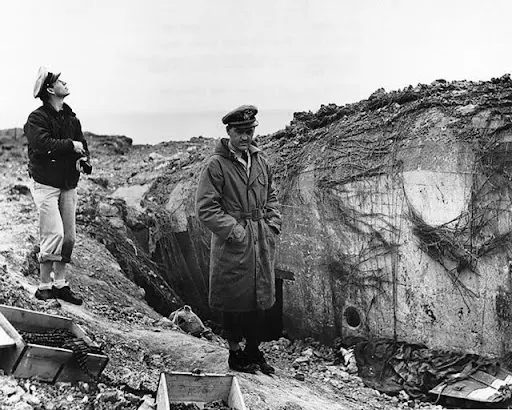
Eisenhower Visiting Point Du Hoc after capture:
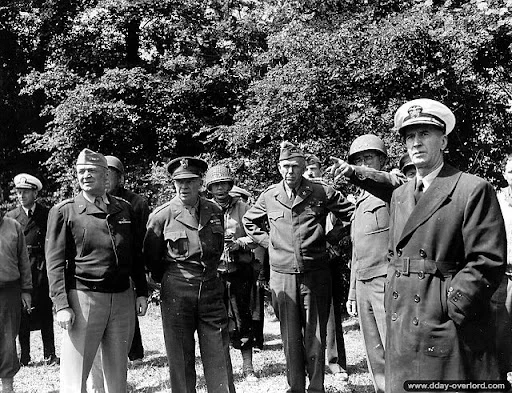
Credit: US Army photo, Public Domain via Wikimedia Commons
The Linchpin
Of all the Texans, indeed of all the soldiers who took the fateful trip across the English Channel, Eisenhower counted on one man more than any other. While the commander had been an occasional Texan, James Earl Rudder was a Lone Star man to his core. Born and raised in Eden, Texas (practically the exact geographic center of the state), his football abilities took him to college. First, at Tarleton and then at “the Agricultural and Mechanical College of Texas,” now Texas A & M. Like all students at A & M in the 1930s, Rudder was male and a cadet in the corps. On graduation, Rudder received an Army commission that he served in the reserves for eight years while he became a hot commodity football coach, first at Brady High near his hometown and then back at Tarleton.
Earl Rudder
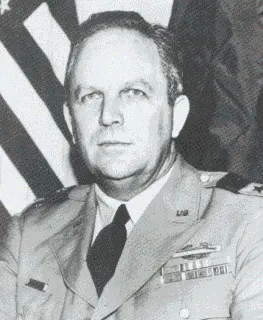
Credit: US Army photo, Public Domain via Wikimedia Commons
When all hell broke loose, Rudder’s reserve commission became an active duty commitment. By June of 1944, Rudder was a lieutenant colonel in command of the U.S. Army’s 2nd Ranger Battalion. The best football coaches know tactics well and how to motivate their men to physical superiority. Instilling teamwork and obliviousness to pain or anything that might distract the group from its objective is the largest tool in a coach’s toolbag. So maybe it is not surprising that Eisenhower, who had played and coached at West Point, turned to his best coach for the tallest task of D-Day.
The main American landing zone occupied two beaches, Omaha and Utah. A large promontory jutted into the Atlantic between the two beaches. Rising almost 100 feet straight into the air, Pointe Du Hoc occupied a perfect firing position from which the Germans could rain destruction on either beach. On top of Pointe Du Hoc sat six 155 mm French artillery cannons with a combination of range and firepower that could stop the invasion in its tracks. Earl Rudder’s job was to make sure those guns were silenced. Rudder knew for a while that his mission would include cliff scaling, and he trained his men harder than he had ever driven a football team. In May of 1944, less than a month before the invasion, Rudder and his 225 subordinates learned their exact assignment. Later, the survivors all professed certitude in their ability to accomplish the task.
The rest of the command was not as sure. The plan was for 2nd Battalion to be first in, landing on the beach at 6:30 am, scaling the 100-foot cliff using rope ladders, taking out the Germans at the apex, and disabling the guns in 30 minutes so the first large wave landing at 7:00 am would have a chance of surviving. One staff officer reportedly told Omar Bradley his view of the plan was that it was a suicidal mission; that “three old women with brooms” could keep the Rangers off the top of Pointe Du Hoc.
Point Du Hoc:
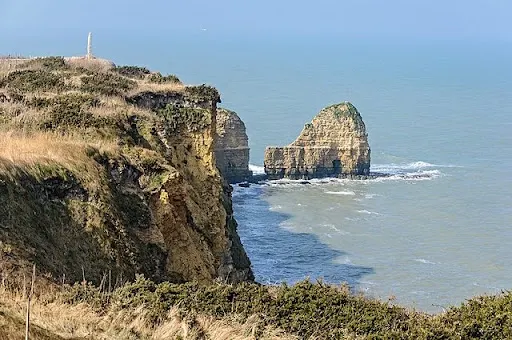
Credit Photo: Myrabella / Wikimedia Commons
The Heavy Guns
Of course, “Rudder’s Rangers” would not be without assistance on their scramble up the cliffs. In fact, for days before the assault, American air and sea power took dead aim at the German fortifications defending the guns. The biggest and most effective blasts came from the perfect source: The battleship U.S.S. Texas. Commissioned in 1914 and overhauled in 1925, the Texas was a lethal fighting machine. The main battery of ten guns launched 1,400 lb armor-piercing shells. On the morning of the attack, the sailors unleashed. In the span of 34 minutes, 255 of those 1400 lb shells found their marks on top of the cliffs. That is 178 tons of munitions in a remarkably short period.
The bombardment served its purpose by driving the Germans back from the cliff’s edge. The battleship and aircraft paused their bombardment so the Rangers could make their way up the cliff before the Germans returned.
USS Texas Firing a Broadside:
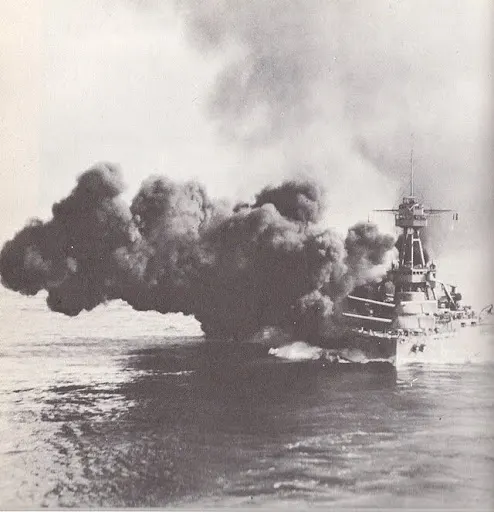
Photo Credit United States Navy photograph, Public domain, via Wikimedia Commons
Best Laid Plans
They call it the “Fog of War” for a reason. To say that nothing is easy is an understatement; everything in war is hellaciously difficult. When the shelling stopped, Rudder’s Rangers were nowhere to be found.
Instead, the navigation in the Rangers Landing Ship malfunctioned. The captain tried to “dead reckon” his way to Pointe Du Hoc but did not correctly calculate for sea drift. To complicate matters, another promontory misled the men to think they were on the right course. Rudder was the first to recognize the mistake and ordered a change in course. Unfortunately, the detour meant a trip of 3-4 miles running parallel to the French Coast.
The detour was costly in three ways. The Rangers lost two landing craft as they made their way up the coast, and the Germans would have time to return to the fortifications after they realized the shelling had stopped. Worse than those two things, the element of surprise was gone. The Germans did not consider Normandy the most likely spot for the main Allied invasion, and they certainly thought a frontal assault on Pointe Du Hoc was out of the question.
By the time the remaining Rangers hit the beach at 7:10 a.m., all that was history. Although it probably never entered his mind, Rudder had a decision to make. Given the reduction in his troop strength, the lack of immediate cover from Texas or other sources, and the fact that the Germans now understood the plan, he could have relied on reinforcement Ranger Battalions. Those Rangers had landed on Utah Beach and were instructed that if Rudder’s Rangers did not achieve the goal, they were to fight their way inland and attack from the opposite side of the fortifications.
It would have been a defensible decision for a commander to make. However, Earl Rudder and his Rangers had not trained this hard and come this far to hope someone else accomplished their mission.
The Ascent
Pointe Du Hoc is not a steep hill. It is a sheer vertical face, approximately nine stories high. The men and their equipment were waterlogged. Water meant more than discomfort. The grappling ropes and ladders needed rocket launchers. The water degraded, and in some instances, eliminated the ability to put the ropes where needed. Every moment became an improvisation as the Rangers struggled up the ascent.
Men were falling, and Rudder was himself twice injured. At this point, it was a savage test of will. Rudder’s training, leadership, and presence pushed his Rangers to do the impossible, as approximately 100 Rangers out of the original 225 arrived at the top of the cliff. When they arrived, they found more than grandmothers with brooms, but now the Rangers had the momentum. They rooted the Germans out of their fortifications, taking some of the first prisoners of war for the day. Soon, they had enough land to establish a base of operations.
German Fortifications Damaged by Shelling from the USS Texas
Credit: US Army photo, Public Domain via Wikimedia Commons
Where are the Guns?
The Rangers were not sent just to grab land. The mission was to eradicate the big artillery cannons. Rudder soon realized something no one had expected. The guns were gone. In their place were painted poles that looked like the guns to Allied aerial reconnaissance. That might seem a relief to normal people, but Rudder and his men understood what had happened.
The shelling from the Texas and others leading up to the invasion had put the Germans’ big guns at risk, so they moved them. The guns still had enough range to be deadly when fired from their new position, wherever that was. When every bone in their body must have cried to signal “Mission Accomplished,” Rudder’s Rangers pushed on and out to find their objective. Some secured the area while a two-man crew explored the nearby countryside.
For the first time that day, luck was on their side. The two-man crew stumbled on the unmanned guns. Using thermite grenades, the Rangers disabled the monsters they had been sent to vanquish. Against all odds, Pointe Du Hoc belonged to the Allies while the millions of men who would end the Third Reich streamed ashore underneath them.
A Texas-born General, depending on a Texas leader of inestimable grit, determination, and tactical brilliance, aided by thunder from the Texas, made it possible for thousands of other Texans to storm the beaches. Of course, it was an Allied effort made possible by Americans from across the country, combined with Brits, Australians, Canadians, French, and others. But no one can deny how much Texas contributed to Allied victory on the Longest Day.
Epilogue
Eisenhower led the Allies to the final victory in Europe and then returned to serve two terms as our 34th President. Like any other leader, Ike was fallible. But his innate goodness and steadiness more than compensated for his minor deficiencies. When we think of what America can be, we can do much worse than model ourselves after Dwight D. Eisenhower.
That can best be seen in the way Ike prepared for D-Day. Most commanders leading the most important invasion in human history would have at least some thought of their legacy. Instead, Ike penned one document on June 5, 1944. He kept it in his breast pocket throughout the next several days. It was a simple statement that contemplated the unthinkable. Ike had written what he would say when the invasion failed. In the statement, he took total responsibility for the failure and praised the valiant efforts of the fallen and the retreating. Of course, Ike never had to broadcast or publish his words. Acknowledging one’s inadequacy, however, when the entire world depended on you, was vintage Ike.
The Texas continued to fight. Most immediately, as the troops moved into France from the beaches, the Germans took up defensive positions, assuming they were outside the range of the Texas’ guns. The Germans based that assumption on the fact that there was a limit to how high the guns could be angled, which was in fact true. In an astounding bit of Naval ingenuity, however, the crew intentionally flooded the torpedo tubes on one side of the ship, causing it to list. That maneuver increased the angle and caught the Germans by surprise again, driving them further back off the beach.
After victory in Europe, the Texas steamed to the Pacific and played a similarly vital role in the Battle of Iwo Jima. Decommissioned in 1948, the State of Texas saved the battleship from the scrap heap. Schoolchildren donated to help fund part of the overhauls. For decades, the ship served as a monument that could be toured at San Jacinto Park. A lack of traffic there led to a plan to move the ship to Galveston and complete a renovation to turn it into the first-class historical experience it should be. That effort is ongoing.
Of the original 225 Rudder’s Rangers, less than 75 were still fit for duty when relief came on June 8. One hundred fifteen men were dead or missing in action. The others, however, continued to fight as the Allies swept across France into Germany. A fascinating discussion with some of the survivors can be seen here.
Earl Rudder also continued to fight. After D-Day, he assumed command of the 109th Regiment, which played a key role in the Battle of the Bulge. He was among the most decorated officers of the war, rising to full colonel while on Active Duty and to Major General in the reserves before he retired in 1957.
Rudder’s contributions to Texas, however, had just begun. He became Mayor of Brady without campaigning, took over a Land Office that had been stricken by scandal, and eventually became the Texas Land Commissioner, a statewide office. From there, he moved to his alma mater, becoming President of Texas A&M in 1959 and chancellor of the A&M system in 1965, where he served until his death in 1970.
Ruddder’s tenure at Texas A & M was remarkable as his time saw racial desegregation, transformation into a co-educational institution, and finally eliminating Corps membership for all students. Former students did not always welcome these changes, but Rudder envisioned Texas A&M as a “sleeping giant.” The changes were necessary to meet the school’s potential. Today, the campus is the largest in the United States, so “giant” was probably the correct term. Rudder’s extraordinary leadership was as evident in his civilian life as on the battlefield.
Of course, Texas grew into the nation’s second-most populous state, with an economy that is the eighth largest in the world. Of the 700,000 Texans who served in World War II, 22,000 never returned.
And America? In the decades following the war, America rebuilt Western Europe and Japan, created rock and roll, ended legal discrimination, put a man on the moon, and won the Cold War. The sacrifices made by so many Texans and Americans on D-Day and throughout the war paved the way for a period of prosperity and opportunity here and abroad, unlike anything the world has ever seen. Today is a day to remember the heroes of Pointe Du Hoc. More than that, it is a day to remember why they fought. Hopefully, it is a day to remember we still have something worth fighting for.
USS TEXAS in 2011

Sankenbruck, CC BY-SA 3.0 https://creativecommons.org/licenses/by-sa/3.0, via Wikimedia Commons
