


Field Guides
Ozona, Texas
(Crockett COUNTY)
Canyon trails, history, and starlit nights across wide horizons.
Highlights
Crockett County and Ozona, its county seat, sit on the dividing line between the Hill Country and West Texas. It has the best of both worlds. If you love the outdoors, you will love it here. Part of the reason is sheer size. At just over 1,800 acres, Crockett County is the eighth-largest county in Texas by land area, while ranking 225th in population.
All that land is diverse. Rolling hills generally characterize the Edwards Plateau, but the western half of the county, bounded by the Pecos River, features mesas, plateaus, and canyons. There is a slight elevation here, from 1,500 to 2,800 feet above sea level. The ground cover changes from Pecan, Sugarberry, and Black Walnut trees with considerable Ashe Juniper in the eastern half of the county to scrub brush and more desert-friendly flowers in Crockett County’s western half.
Of special note is the Escondido Draw Recreational Area. This slice of paradise is the second project of the Texas Motorized Trails Coalition, a non-profit dedicated to providing off-road adventure activities. If you have a jeep, a dirt bike, or binoculars, this is the place for you. Binoculars? Yes–it also happens to be a world-class birding site.
Crockett County also earns renown among hunters. White Tail deer, turkey, dove, quail, and hogs are there for the taking. The county maintains a helpful page of hunting businesses; you can find more in Where to Drop a Dime. There are many more historical and nature opportunities in the Things to See and Do section.
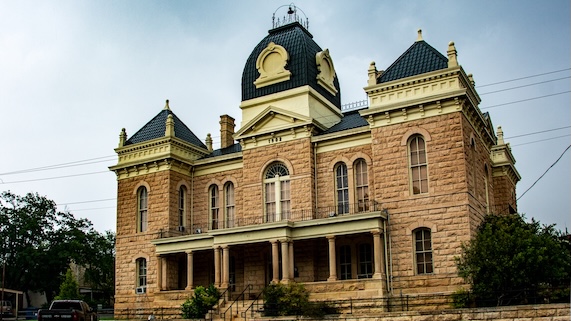
The County Courthouse
We love a citizenry with the right priorities, and 1902 Crockett County fits the description. That year, the county commissioned San Angelo architect Oscar Ruffini to design and build a courthouse with ample space for social events. The new building replaced a 1891 frame building, courtesy of a local carpenter. Ruffini complied with the request. In its early days, the courthouse saw cowboy dances, box suppers, Christmas trees, and round-up celebrations.
Ruffini’s work was more than efficient. He was a master of Napoleon’s Second Empire style, and his work here would be comfortable along the Seine. The limestone is native to the area and was hand-sawed. It turns a beautiful desert pink at sunset. We admire the “covered porch” entrance, the symmetrical wings and bays, and the narrow arched windows. What we truly love is the idea of cowboy dances in a building befitting French society.
Things To See And Do
There is much to Crockett County beyond off-roading at Escondido and hunting. To get a feel for the area and its history, the Biggest Little Museum in West Texas does a great job. Three floors take you from pre-history to settlement. This is not your typical county museum. By the way, the museum’s name is a play on Ozona’s nickname, “The Biggest Small Town in the World.”
We keep talking about how diverse the terrain and flora are. You can see it for yourself at the Crockett County Interpretive Trail and Visitor Center. It is educational (water preservation) and beautiful. In town, make sure to see the sculptures. One is of county namesake, Davy Crockett, and the other memorializes the area’s settlers under the name of “The Ties That Bind Us.” Both are well executed.
Fishing in the county is challenging because most of the shorefront along the Pecos River is privately owned land. Texas Parks and Wildlife describes sections of the river here and special bait regulations here. The better option for Texas Ten would be arrangements through a private ranch. In addition to Chandler Ranch and Twistflower Ranch in Crockett County, Bar K in Val Verde County has a deserved sterling reputation.
We have seen all the forts. There is not much left of Fort Lancaster, but we heartily recommend making an effort to see it. The visitor center is excellent, and the person on site was full of information. Although the fort was not manned for long, its history is considerable, including the presence of Buffalo Soldiers. The ruins are just what the name implies, but they evoke admiration for those who served in such an out-of-the-way and fierce place. We would like to revisit the “hands-on” experience, where you can use artifacts from a soldier’s life on the frontier.
While visiting the fort, take the detour up to the observation point for one of the more impressive views in Texas. Speaking of views, the low population density makes for very low levels of light pollution. That means spectacular stargazing. Although stargazing can be done anywhere, the Twistflower Ranch and Chandler Ranch specialize in taking your breath away.
Food, Drinks, And Music (Eat Local!)
The star of the show is the Hitchin Post Steak House, a long-time favorite for Ozonians (made that up, but it might be right) and travelers of I-10. No nonsense meat done right. Mexican food is abundant; you can choose from El Chatos Restaurant, Pepe’s Cafe, Bryan’s Poco Taco, Mi Taco, Taqueria Mi Casita, or Mi Familia. If you need flexibility, Destiny’s Grill has burgers or tacos. Ozona Donuts & Lunch has donuts to start your day and simple, but delicious meals throughout. Local color and local pizza are at Lion’s Den Pizza. For variety, Punjabi Food offers a taste of India.
Those are all in Ozona. Sheffield is a spot in the road near Fort Lancaster. During the week, stop at the Tin Cup Cafe, an awesome, tell-your-friends-about-it place.
Where To Drop A Dime (Shop Local!)
Crockett County is more focused on the outdoors; retail therapy has not yet taken hold. There are two places to spend a little browsing time and come away with a treat: Petals & Pearls and Close to Our Hearts Country Store.
Special Places To Lay Your Head (Stay Local!)
There are several highlights here. “Luxury Ranch” accommodations can be just what the soul needs for recharging. Chandler Ranch and Twistflower Ranch are among the best anywhere. Consider exploring the surrounding counties for additional options like these. There are also limited short-term rental options, such as The Hummingbird, The Butterfly, and Southwest Sunrise. We would not call Hillcrest Suites or the Republic Hotel of Ozona either luxurious or quaint, but they are clean, solid options.
For The Professional Traveller (Campgrounds and RV Parks)
Special Events
December is the ideal time to visit Ozona and Crockett County for a special event. No, they are not all holiday-driven. Instead, Deerfest is a celebration of the hunting community. Fort Lancaster often hosts special events; check their website for details.
Fore! (Golf Courses)
1,800,000 acres of beautiful land and one of the best climates in Texas. Only one golf course, a private one at that? There is an opportunity here for golf course developers. Until then, either get an invite to play the nine-hole Ozona Country Club, or visit one of the surrounding counties, Tom Green in particular.
Ozona Country Club
State Hwy 163
Ozona, Texas 76943
(325) 392-2520
Getting to Crockett County
Drive west on I-10 from San Antonio, exit at Ozona. It is 205 miles from the Davy Crockett statue at the Alamo to the Davy Crockett statue in Ozona. Pretty simple. There are no Davy Crockett statues in El Paso, but it is about 346 miles from our westernmost city to the Ozona exit on I-10. State Hwy 163 bisects Ozona on a north/south axis. The drive north on 163 to Sterling City is beautiful. From the state’s geographic center in Brady, Ozona is two hours and 10 minutes southwest.
If you are flying in on a major carrier, you will also be driving for a while. The closest airport is San Angelo Regional Airport – Mathis Field, located about 90 miles north, which handles only American Airlines with an automatic stop in Dallas. The next closest is Midland International Air & Space Port, located 130 miles to the north, which offers United, Southwest, and Delta, in addition to Southwest. Most of those flights will also be connectors. Or San Antonio International Airport is 205 miles away, but with all airlines and no stops once you land or arrive in the Alamo City. Smaller craft can use Ozona Municipal Airport. The 6,000-foot runway will handle most small planes and jets.
History
Crockett County was important to prehistoric peoples because several springs provided water at the edge of a desert region. Early inhabitants were the Lipan Apache and the Tonkawa. As in the rest of the region, by the 19th century, the Apache and Tonkawa gave way to the Comanche.
The first Europeans likely passed through in 1590 when Gaspar Castaño de Sosa led a group of miners from Mexico to what is now Santo Domingo, New Mexico. Spaniards returned in 1694, led by Juan Domínguez de Mendoza on the first mission from New Mexico to occupy the new “kingdom” of Texas. Mendoza, however, did not establish anything permanent in the current Crockett County. The Native Americans in the area remained undisturbed until 1849, when legendary Texas Ranger and Indian Agent Jack Hays and his group passed through on their way to California.
Permanent Anglo settlement, however, dates back to 1855. After an inspection trip of the trail from San Antonio to El Paso, the Army’s Col. Joseph Mansfield recommended more protection in the area for travelers against Indian raids. The Army acted on the recommendation by building and manning Fort Lancaster, which became a permanent fort in 1856. With the advent of the Civil War, the Union abandoned Fort Lancaster. After a brief attempt to occupy the post, Texan and Confederate forces followed suit.
In 1867, however, the Army returned and again took up a position there. Notably, some of the soldiers responsible for manning Fort Lancaster were African American, specifically the Buffalo Soldiers of the 9th U.S. Cavalry Regiment. While movies often depict Indian attacks on Western forts, that rarely happened, and only once in Texas, when the Kickapoo charged Fort Lancaster. The attack was a success as the Kickapoo took most of the cavalry’s horses despite determined rifle fire. The Army may have lost that battle, but it won the war. As the Indian threat receded in the 1870s, the Army again abandoned Fort Lancaster.
With the area now fully open to settlers, Texas formed Crockett County in 1875, named in honor of the fallen Alamo hero. The original county was much larger, including all or part of what are now Sutton, Schliecher, Val Verde, Kinney, and Edwards Counties. Although the county was the size of a small state, government administration centered in Kinney. The ranchers trickled in with their cattle and goats until, by 1891, the population was large enough to support a proper county, sans the surrounding areas.
Ozona became the county seat when it was nothing more than a developer with a prolific water well. The name stems from the abundance of fresh air provided by the local climate. The new county seat grew quickly at first, aided by the fact that the entire town of Emerald, which had lost the county seat election, moved to Ozona. From that beginning, Crockett County moved forward with remarkable singularity. Sheep did better than cattle, and cattle did better than crops. The economy took shape as an agricultural one, with sheep and goats as the driving force; cattle ranching and farming existed, albeit in smaller quantities. Oil entered the picture in 1925 with the discovery of significant quantities of oil for production and generous royalties for the ranchers, but not enough to create a mania and boomtowns.
Not much has changed today. The latest statistics we could find still list Crockett County as having the most sheep and producing the most wool in Texas, as well as having the third most goats and the fourth most mohair. Crockett County is a prosperous area, with a median family income above both state and national averages, and the number of people in poverty significantly below those averages. Those marks are surely tied to the land, as educational achievement lags far behind the rest of the state and the nation, both in terms of high school graduation rates and post-secondary achievement. Crockett County is predominantly Hispanic, with 67% of the population identifying as Hispanic, 32% as non-Hispanic Caucasian, and 1% as African American.
Politically, Crockett County has long exhibited an independent streak, sometimes voting Republican when most rural Texas counties were strongholds for conservative Democrats, but then siding with Democrats when most rural counties had switched to the GOP. Today, the GOP has a firm hold on the county, but not quite to the extent as in many other Texas rural areas, as “only” 76% of Crockett County’s votes went to President Trump in 2024.
British rockers Goldrush released an album titled Ozona after their tour bus broke down in the town. John Moore Shannon was a rags-to-riches sheep rancher who made his fortune in Crockett and Irion counties. As they had no children, their estate established the Shannon Hospital system in San Angelo, the area’s largest medical provider.