


Field Guides
Comanche, Texas
(Comanche COUNTY)
Rodeo nights, oak-shaded streets, and proud frontier history.
Highlights
First, we love the name. The Comanche story is integral to Texas history; whatever we can do to remind today’s Texans of the people who once ruled the Plains in such a fierce and majestic manner is worthwhile. The name is prophetic of the fact that Comanche County is still known for hunting, being one of the best places in the state for deer and exotics. Not many do it from horseback today, however.
Proctor Lake is a 5,000-acre gem with excellent fishing, camping, and lazing around. Hunting and fishing tourism created a mini-boom downtown with an active square and several places to relax. Comanche’s natural beauty is worth finding in its slightly out-of-the-way location.
The County Courthouse
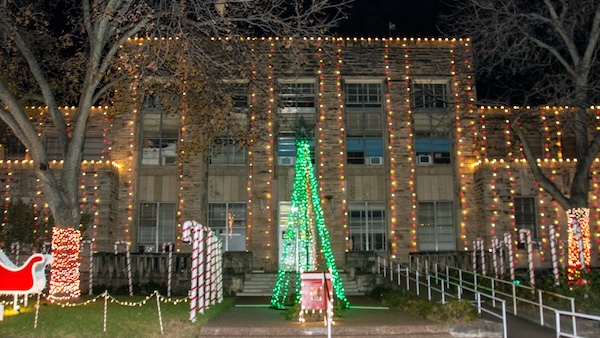
Comanche County is on its fifth courthouse. The county seat was originally located in Cora, but when new counties were formed and their boundaries changed, Cora lost its designation as the county seat to Comanche. So the log cabin courthouse in Cora gave way to a log cabin in Comanche. When that log cabin inevitably burned, the first stone courthouse took its place in 1875. However, the original courthouse in Cora survived and is still important in Comanche.
One of Texas’s early trials of the century occurred in this red brick structure. Famed killer and gunslinger John Wesley Hardin was the defendant for the murder of Brown County sheriff Charles Webb in a Comanche saloon. John Wesley did not like people messing with his celebration, that day related to a horse race. Hardin initially escaped, but the law caught up to him in Florida and returned him to Comanche for the trial.
The interesting part of the trial was the commotion surrounding it. Recalling the vigilante justice surrounding Hardin’s escape, the judge threatened the citizenry that regular order would prevail or… The “or” was that the judge would arm Hardin with two pistols and set him free to see what would happen. Despite the big talk in town, no one was up for facing a re-armed Hardin, and the trial proceeded to a verdict. The jury convicted Hardin, and the judge sentenced him to 25 years. Hardin went to prison in Huntsville. He served for over 15 years before being released for good behavior. Despite having the appearance of a reformed man, Hardin was a stone-cold killer at heart. About a year after his release, he met his end in an El Paso saloon.
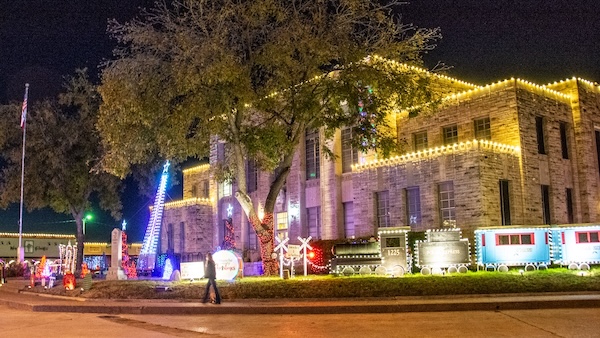
In 1890, the county went larger, opting for a three-story Victorian model that lasted until 1939. The current courthouse replaced the Victorian building with a modern limestone structure, three stories in the middle, accompanied by one-story wings on each side. Although the limestone is local, we are unsure whether the style evokes the county’s ethic, which is more rough and tumble than the clean lines suggest. Comanche does a great job lighting the courthouse and the lawn during the holidays.
That lawn serves other purposes. The first courthouse in Cora was later moved in pieces and reassembled, first outside of town and then on the courthouse lawn. Today, it is the oldest standing courthouse in Texas. It stands in the shade of a giant oak, known alternatively as “The Fleming Oak” or “The Hanging Oak.”
The Fleming Oak refers to Martin Fleming, an early settler who, as a boy, survived a Comanche attack, using the tree’s massive trunk as a shield against the Comanche arrows. As Comanche grew, the town began to clear the grove of oaks. An impassioned Fleming managed to save “his tree.” Between the Comanche attack on Fleming and his family and his keeping the tree, the Hardin trial took place. Which brings us back to vigilante justice. After Hardon’s first escape, the locals hanged three of Hardon’s family/accomplices in retaliation for Deputy Webb’s death. Whether that is the exact tree is questionable, but it makes a great story.
Things To See And Do
Comanche is deer country, primarily White-tail and axis. Turkey, dove, waterfowl, and hogs provide plenty of variety. Our “Where to Drop a Time” section lists guides, private ranches, and lease opportunities. Proctor Lake is a popular fishing hole, with abundant striped bass and crappie; that doesn’t mean you cannot catch a white bass, catfish, or sunfish.
Comanche County offers three winetasting opportunities: Brennan Vineyards, J.W. Hardin Wine Company, and Cockrell Vineyards. For beer lovers, there is Baby Cow Brewing, a microbrewery, and Stone Eagle Beer Garden, one of our favorite on-the-square joints in Texas.
The rich local history reveals itself at the Comanche County Museum, open Thursday through Saturday from 10:00 a.m. to 4:00 p.m.
Food, Drinks, And Music (Eat Local!)
Comanche County only has about 13,000 restaurants, so the breadth of restaurants is impressive. Most of the action is on and around the county square in Comanche. Harvest La Creperie is an extremely well-reviewed microbakery that turns out acclaimed crepes and other delicacies for breakfast, lunch/brunch, and early dinner. Star Beau’s, City Center Cafe, and S2S Lunch & Steakhouse are all in the Texas cafe/diner business.
Tex-Mex offers the most choices: El Tapatio Mexican Restaurant & Cantina, Los Juanes Mexican & BBQ, Lozano’s Moonwalk Mexican, and Junior’s Tacos. If you want a slice, there is State National Pizza. For an afternoon treat, dessert at the Soda Shop is the way to go.
In addition to Stone Eagle Beer Garden, Baby Cow Brewing, Brennan Vineyards, J.W. Hardin Wine Company, and Cockrell Vineyards for handcrafted alcohol, the 1895 Bar is great for craft cocktails and live music. Bar foods are available, but meals are not on the menu.
Near Proctor Lake, post-fishing meals can occur at Taquito Millonario or Country Pickin’s Cafe. Highway 6 carries travelers through De Leon. If hungry, there are two cafes, a drive-in hamburger stand (love those), or a Tex-Mex stop to choose from: Texas Street 301, Highway 6 Cafe, Doc’s Drive-In, or Prado’s Cafe. For an adult beverage, try the Gallery Bar.
Between Comanche and Rising Star on State Hwy 36, there is a nifty stop at Cook’s Fish Barn for weekend nights only.
Where To Drop A Dime (Shop Local!)
Comanche is not a retail mecca, but a tour of the square and the surrounding streets might produce some good finds. The boutique category includes Westward Boutique, Bucking Heifer Boutique, and Barbed Wire & Lace Boutique. The Shops at Woven Roots is a multi-vendor space with gifts and apparel. For antiques and vintage, try Comanche Mercantile, Courthouse Square Mall, and Dee Dee’s Place. Fulfill your fabric dreams at Stitching Sisters Quilt Shop. Our favorite is Sorrell Farms–everything you need for the world’s greatest charcuterie board. The real score, however, is Kimmel Boot Co., where you can get the boots of your dreams. Bring the bankroll, though.
The other use for your hard-earned dough is local knowledge and access to the best hunting places in the area. Private ranches, guides, and lease opportunities include:
Special Places To Lay Your Head (Stay Local!)
In addition to hunting lodges, there is an excellent place on the square, the two-bedroom Jean Marie Suites. A variety of country houses are available for short-term rental. Artesian Ranch has a nice B&B.
For The Professional Traveller (Campgrounds and RV Parks)
Special Events
Comanche hosts at least three special events throughout the year. Each April, two-wheelers from around the state gather for a Texas Motorcycle Riders Association rally with food, competition, and music. In June, the Comanche Rodeo and Parade showcases all the cowboy talent in and around Comanche. In mid-December, Comanche turns its square into one of the better holiday extravaganzas in Texas.
Fore! (Golf Courses)
The P.A.R. Country Club is a quality semi-private 18-hole track next to Proctor Lake. While the lake is not directly in play, plenty of water is on the course. Definitely an enjoyable outing.
P.A.R. Country Club
1658 Highway 2861
Comanche, TX 76442
(254) 879-2296
Getting to Comanche County
Comanche County is 80 miles southwest of Fort Worth, but that 80 miles is all rural. The nearest interstate is I-20, 50 miles to the north at Cisco. The roads that get to Comanche are all state highways: State Hwy 36 moves from the southeast to the northwest, State Hwy 16 runs more or less north and south, and State Hwy 377 travels northeast to southwest (obviously, the reverse is true for each road also). From a broader perspective, Comanche is an hour and 15 minutes northeast of the state’s geographic center in Brady.
Flying in for the hunt likely means landing at DFW International or Love Field if you insist on Southwest or Delta as an airline. DFW is a two-hour drive, and Love Field is two hours and 15 minutes away. Abilene is closer, at an hour and 15 minutes away, but every Abilene flight goes through DFW anyway, making the puddle jumper a wash. Smaller craft will aim for Comanche County-City Airport first. Hamilton Municipal Airport and Coleman Municipal Airport are two nearby smaller airports. The best option is Stephenville Clark Regional Airport if something bigger is needed.
History
For thousands of years, Native American tribes, including the present-day Comanche, roamed the plains north and west of Spanish settlement. The last to control the region before the Comanche was the Lipan Apache, but they proved no match for the fearsome horsemen. However, the confusing and constantly shifting alliances with the Spanish made the struggle a long one.
By the 1850s, the Comanche were ascendant in the area, chasing buffalo, elk, mustangs, cattle, and bears. Their world was about to change over the next two decades. In 1854, the first Anglo settlers arrived in the area; by 1856, the state created Comanche County out of Coryell and Bosque counties. The county seat moved to Comanche in 1859, and a real community began to grow.
The first settlers concentrated on cattle ranching, augmented by wheat and corn. In the first years of settlement, the U.S. Army blunted danger from the Comanche. The Civil War stripped that protection away. Repeated Comanche raids induced most of the survivors to leave; by 1866, the population shrank to a mere 60 settlers.
The end of the war and the redeployment of the Army to the Texas frontier brought settlers back in droves. Comanche became the de facto capital of West Texas. The Comanche Chief, still in circulation, was the primary paper serving up to 50 counties. The local economy followed suit. Population growth was explosive, from the remaining 60 settlers at the war’s end to over 8,600 residents at the 1880 census, just 14 years later. Progress continued full steam ahead as railroads connected the area to bigger markets.
Most of the new settlers came from the ravaged South. Statistically, there were very few Black citizens, but enough to cause discomfort among the transplanted southerners. In retaliation for alleged black on white crime, the majority ran all the African Americans from the county, a situation that lasted for decades.
Nevertheless, the economy continued to grow. Ranching remained at the center, supplemented by crop production. The crop of choice changed over time, but included corn, wheat, cotton, and peanuts. A short-lived oil boom in the early 1920s augmented the cattle and crops.
Decades of progress hit a brick wall as the Great Depression and the Dust Bowl took their toll. While Coleman County farmers and ranchers had faced adversity before, the challenges that began in the 1930s were of another magnitude. After surviving the initial difficulties, they had to deal with the severe Texas droughts of the 1950s. In addition to the weather, increased farm mechanization reduced the need for human hands. Thus, after decades of growth, the population level stabilized near its current 13,000.
More recently, the county gained a stable water supply when a dam on the Leon River created Proctor Lake. The economy remains predominantly agricultural with some oil production. De Leon, the second largest city in the county, is one of the state’s primary peanut processing centers.
Today, the population of Comanche County is 67 % Caucasian and non-Hispanic, 29% Hispanic, 3% mixed race, and 1% African-American. Regarding high school graduation, educational achievement is on par with Texas averages and slightly below national averages. College completion in Coumanche County lags further behind. Median family income is 20% below the Texas standard and 25% below the national mark. The poverty level is about 10% above the Texas and national averages.
Robert Hill was the most prominent resident of Comanche County. An orphan from Tennessee, he made his way to Comanche in 1874, where his older brother edited the Comanche Chief. Hill engaged in various activities and loved the outdoors, particularly the buttes around Comanche. On his repeated climbs, He became fascinated with the fossils he discovered. These discoveries led to a celebrated career as one of America’s greatest geologists.