


Field Guides
Morton, Texas
(Cochran COUNTY)
Dust roads, blue skies, and a frontier spirit that still runs deep.
Highlights
Cochran County’s tagline is “The Last Frontier” because it was one of the final counties formed in Texas. The name fits the place to a T. Cochran County is quintessential West Texas, almost to the point of stereotype.
Wide-open spaces do not begin to describe the terrain and sky. Ranching, farming, and oil are what the area knows and does, with no use for extracurriculars. The residents travel to Lubbock for the finer things. You can get a sunrise or sunset picture that dramatizes the sky, get a feel for the Dust Bowl, or document agricultural and energy production. But tourism is not a thing. People are in Cochran County because they live here, work here, or travel through it.
One highlight for Texas Ten—Cam Dockery of Barely Making It created the wood-carved Native American on the courthouse lawn as chainsaw art. We later got to know Cam, who lives in Whitharral, a town neighboring Hockley County. He is talented beyond description, and the courthouse sculpture is a striking example of his public art.
The County Courthouse
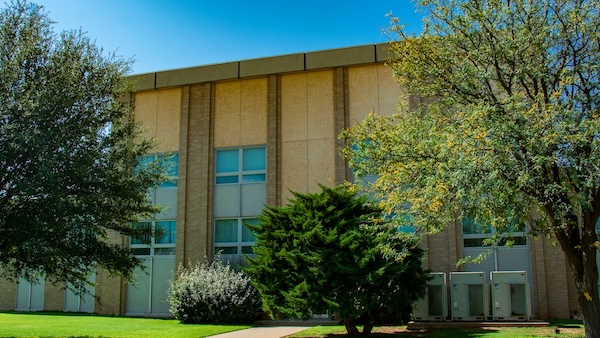
Why do people bother with a good thing? The Cochran County Courthouse was built in 1926 in a traditional revival style. While not award-winning, the original structure looked the part. In 1967, however, the county reimagined its most important building in a modern style. It now looks more like an office building than a seat of justice. To each their own, but Texas Ten says it was an unfortunate transformation. Only the wood carving on the lawn saves it.
Things To See And Do
Farm, ranch, or make energy. That is what everyone else in Cochran County, or close to it, does 24/7. They also drive a lot, mainly to Lubbock but sometimes across the state line to New Mexico. The points of interest are the Native American statue on the courthouse lawn and Silver Lake, a salt lake that was the site of an infamous raid and massacre in the war between the US Army and the Comanche as the conflict over mass Buffalo hunting explded.
Visit The Last Frontier Museum to see the county’s history. Call ahead as viewing is by appointment.
Hunting opportunities exist for Pronghorn Antelope, Mule Deer, Dove, and Quail, but you need a lease.
Food, Drinks, And Music (Eat Local!)
We hope you like it simple. There are two good cafes in Morton: Chillax Cafe and R&H Grill. State law says every county must have Tex-Mex available. In Cochran County, that means Gracias Cafe. In Whiteface, try the Outlaw Cafe. In addition to good food, the Outlaw has Friday night music and dancing.
Where To Drop A Dime (Shop Local!)
Besides the essentials, Butterfly Kisses Floral & Gifts in Morton is your shopping destination for flowers, floral arrangements, and small gifts.
Special Places To Lay Your Head (Stay Local!)
Maybe you should have an RV. There are basic cabins at the RV Park.
For The Professional Traveller (Campgrounds and RV Parks)
Special Events
Last Frontier Day is usually held in May or June.
Fore! (Golf Courses)
Morton Country Club is a wide-open nine-hole course. Hard to miss the fairways, but the greens are small and well-kept.
Morton Country Club
2250 FM 1780
Morton, TX 79346
(806) 266-5941
Getting To Cochran County
Westward, Ho! Cochran County is on the New Mexico border, about 1/3rd up the north/south panhandle border. Go to Lubbock, then straight west to New Mexico. State Highways 114 (east/west) and 214 (north/south) intersect in Morton. The closest interstate is north/south I-27 running through Lubbock, 60 miles to the east. The east/west interstates are even farther away, with I-40 being about 120 miles north of Morton and I-20 about 135 miles south of Morton. That position results in Morton being about a four-hour drive in the northwestern direction from the state’s geographic center in Brady. Windshield time from other Texas cities is here.
For flyers, American, Southwest, and United all utilize Lubbock’s Airport, 60 miles away. The closest Delta can get you is 145 miles to the South in Midland. Smaller craft can try Cochran County Airport next to Morton or slightly larger operations in Littlefield or Levelland, each about 30-40 minutes from Morton.
History
5,000 to 10,000 years ago, hunters inhabited the area now known as Cochran County. The Kiowa and Apache Natives came to the area in the 1600s and fought Spanish conquistadores, acquiring their horses. In the 1700s, Comanches hunting buffalo entered the area and began warring with the existing tribes, eventually winning and controlling the territory. That era ended as Anglo settlement to the immediate east began, and ended as the United States Army systematically removed the remaining Native American nations in the 1870s and 1880s.
The Texas Legislature formed Cochran County in 1876 from land previously part of Bexar and Young Counties. The county takes its name from Robert E. Cochran, a defender of the Alamo who died in the fight. The County Seat is Morton.
At the time of Cochran County’s establishment, the XIT ranch controlled most of the land. This ranch, which owned 3,000,000 acres in 1887, was dominant in the county’s early days. The portion of the ranch in Cochran County, known as the Yellow House, served as the breeding grounds for the ranch operation.
Although uninhabited then, the county’s most significant historical event happened in 1877. In July of that year, a company of Buffalo Soldiers and a group of buffalo hunters pursued into the county a group of Comanche suspected of livestock theft. The company ran into Quanah Parker, who used the group’s translator to deceive its leadership. As a result, the central portion of the troop futilely searched for the Comanche. Failure to adequately supply and ration resulted in extreme water deprivation, lasting almost four days in searing heat and wool suits. The group ended up losing five men, and all suffered immensely in what is known as the Buffalo Soldier Tragedy of 1877.
Population growth was slow due to the large parcels of land belonging to ranches. In 1901, ranchers like George Washington Littlefield and C.C. Slaughter also owned large tracts, and in 1920, there were still only fourteen ranches, housing sixty-seven people.
The construction of the Santa Fe Railroad in 1920 marked a significant turning point in Cochran County’s history. This development led to the establishment of the existing towns and a migration of residents to Morton. Despite the challenging farming conditions and frequent sandstorms, the county’s economy stabilized with cotton growth and oil discovery in 1936.
Underwater irrigation improvements in the 1960s proved profitable for the county, and by the late 1980s, cotton, wheat, and sorghum supported the agricultural income in the region. Horse meat packers and oil production supported the local economy even as the railroad abandoned its tracks in the mid-1980s.
As with the rest of rural Texas, the country was conservatively Democratic, but in 1980, it began trending to the solid red it is today.
Today, the population of Cochran County is 2,547, with a racial composition of 60% Hispanic or Latino, 36% caucasian, non-Hispanic, 2.5% African American, and the remainder Native American or multiple races. The County is significantly below state and national educational attainment and income averages.
Cochran County is proud of its native son, 1972 All-American Football inductee Don E. Rives.
Primary Sources: