


Field Guides
Port Lavaca, Texas
(Calhoun COUNTY)
Shrimp boats, bayside sunsets, and Gulf breezes shaping life on the coast.
Highlights
Calhoun County is the workingman’s version of the Texas Gulf Coast. The county is basically the western shore of Matagorda Bay, a vast inlet off the Gulf of Mexico. Port O’Connor is a small, relaxed beach village where the bay meets the Gulf. Moving inland from Port O’Connor, you pass Indianola, one of Texas’s premier ghost towns. Indianola was a thriving community in the late 1800s, but it could not withstand the force of two killer hurricanes. Had the people of Galveston paid heed, that city’s future might have been different. Alas. Still, Indianola is a site rich in history and is now beautifully serene.
Where Matagorda Bay becomes Lavaca Bay, you will find the economic hub of the region, the Port of Lavaca. Several large plants (Formosa, Alcoa, DuPont) use the deep water and protected port. Perhaps more interesting is the bay’s abundant fishing, particularly for shrimp and oysters. Port Lavaca would likely be his home if Bubba Gump were a Texan.
Quiet beach life with all you can catch to eat? Sign us up. But check the weather before you go. The area is a frequent hurricane target. Beyond Indianola’s sad history, there is the fact that Port Lavaca holds the state record for the highest sustained winds at 170 mph during 1961’s hurricane Carla.
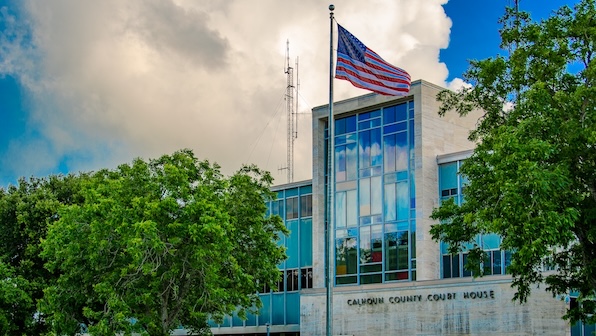
The County Courthouse
As might be expected of a county that regularly confronts Mother Nature at its worst, the Calhoun County Courthouse is relatively new. Completed in 1959, the structure is an impressive mid-modern design. We could not help but notice the amount of glass in the building’s exterior, which seemed brave in the event the 170 mph winds returned.
Things To See And Do
Fish. Fish. Fish. Calhoun County is likely the best value fishing in Texas. You can hit trout, redfish, flounder, black drum, and more from the jetty in Port O’Connor. Charters in the Gulf can find anything from red snapper to shark to Mahi-mahi. Fly fishing in the marshes is great fun. Some fish from Port Lavaca’s many piers; others do their angling while wading or kayaking. But our favorite idea is to fish from the outdoor cafe at the Indianola Marina. This iconic location offers all the comforts of home and big catch possibilities. The only downside is that everyone sees it happen when the big one gets away.
If you can’t catch them, shoot them. The hunting is as good as the fishing in Calhoun County, particularly if you can cook a duck. The waterfowl is world-class here. White-tail and Hogs are plentiful, and you might do a gator hunt if you need boots.
Or maybe just watch them. The birding is fantastic. The Powderhorn Wildlife Management Area, operated by Texas Parks and Wildlife, is a 15,000-acre preserve offering group and appointment viewing.
Indianola is worth a visit outside of the marina. Its history is amazing. Start with the monument to one of the premier early explorers of the New World, René-Robert Cavelier, Sieur de La Salle. The Frenchman was responsible for settlements in Canada, Ohio, and the Mississippi River and for claiming Louisiana for France. However, La Salle’s visit to the Texas coast led to his undoing. Robert Weddle wrote a fascinating account of it all, but the upshot is that one of the most important men in the history of our continent ran his ship aground not far from the marina.
Decent scuba divers can find the submerged remnants of the first Calhoun County Courthouse of the Indianola shoreline, a testament to nature’s fury.
Another ill-fated expedition ran through Indianola when Jeff Davis, later of the Confederacy, engineered an experiment to introduce camels as the preferred pack animal of the Southwest. Like La Salle, the camels landed at Indianola. Like La Salle before them and Jeff Davis’ Confederacy after them, the camels failed to achieve success. But they are remembered in Indianola.
The Calhoun County Museum in Port Lavaca has more details on Indianola and the region’s rich history. A visit to the Halfmoon Reef Lighthouse is a must for photographers, sea lovers, and admirers of lonely lighthouse keepers.
Food, Drinks, And Music (Eat Local!)
We already teased it, but the best combination of atmosphere, food, and scenery has to be the Indianola Fishing Marina, Bait Shop, Restaurant Bar & Grill. As much fun as the marina is, do not sleep on the 5D Steakhouse (a small Texas chain), particularly if you want to impress. LaVaca BBQ is renowned, earning a Texas Monthly Top 50 nod in 2021.
In Port Lavaca and Port O’Connor, seafood and Mexican food reign as co-kings. Mexican restaurants usually have fish plates, and fish restaurants usually have Mexican flavoring, so we treat them as one delicious category. In Port Lavaca, there is El Mirador, Habaneros, Monterrey Cafe, Leones Mexican Grill Y Panaderia, Don Julio’s Mexican Restaurant, Los Charritos Express #2, Casa Jalisco, and Mary’s Taquitos. Port O’Connor offers Sharkie’s Bar & Grill, La Loncheria Morenita, Jose’s Mexican Food and Cantina, and Cathy’s (casual, traditional seafood). Nearby, Seadrift has Bubba’s Seafood.
Try Hurricane Junction, Mama’s Kitchen, the Office Bar and Grill, and the Oasis in Port O’Connor for a more varied menu. Texas Traditions Bar and Grill, Scully’s Sports Bar & Grill, and 303 Pub & Grub all offer traditional American dishes in Port Lavaca, while the Green Iguana Grill offers a well-rounded lunch option.
If Asian moves you, there is the Four Seasons (early morning hours for great donuts), Magic Asian, or Taiyo Sushi Fushion, all in Port Lavaca.
If you long for the nightlife, there are more active counties. But a chill brew or cocktail with the sound of the ocean nearby or maybe a Jimmy Buffet tune is a recipe that can be filled at Madden’s Lounge, The Office Bar (as in “I am working late at the Office”), as well as the already mentioned Sharkies, Hurricane Junction, and 5D Steakhouse in Port O’Connor. In Port Lavaca, Texas Traditions Bar and Grill, Scully’s Sports Bar & Grill, Bar El Patron, and 303 Pub & Grub are the go-to spots for late-night entertainment.
Where To Drop A Dime (Shop Local!)
The best money you can spend in Calhoun County is finding the guide to put you on the fish. The second-best thing you can buy is the right bait to get the fish. The third-best thing you can buy is something to take your mind off not getting the fish. In order, then:
Guide Services
All Seasons Guide Service (fishing and various hunting)
Captain Jake Huddleston (fishing and various hunting)
Captain Clint Anderson (Ducks also)
Captain John Mahan (Duck hunting also)
Days Off Outfitters (Duck hunting also)
DB Coastal Outfitters (Duck Hunting and lodging also)
Castaway Lodge (Hunting and lodging also)
Empire Lodge (Hunting and lodging also)
Texas Coastal Adventures (hunting and fishing)
Bay Prairie Outfitters (waterfowl)
Tackle and Bait Shops
Clark’s Bait Shop
Other Equipment Rentals
Paddle Port O’Connor (Kayak Rentals)
Glow Row (lighted nighttime paddling)
Get Over It Shops
Special Places To Lay Your Head (Stay Local!)
Port Lavaca features an abundance of clean, dependable, and forgettable rooms. However, it is not a place to go fishing for a high thread count. For family-style accommodations, we suggest a short-term rental in Port O’Connor. The Inn at Clark’s has boat slips to go with your room and a bait shop nearby. If you have a group looking to fish or hunt, Castaway Lodge in Seadrift might be your place.
For The Professional Traveller (Campgrounds and RV Parks)
Special Events
Aside from the usual holiday celebrations, Port Lavaca is known for several unique gatherings. Heading the list is “Iguana Fest” each April. Iguana Fest is a street party done right, with food, bands, and iguanas. The Texas Gulf Coast is a birding paradise, and Port Lavaca celebrates its part with the Mid-Coast Birding Festival each May. Labor Day and summer is remembered at Flip Flop Fest. The County Fair happens each October. But the beach and the bay are always open.
Fore! (Golf Courses)
Hatch Bend Country Club
579 Meadowview Ln
Port Lavaca, Texas 77978
(361) 552-3037
Hatch Bend is a nine-hole semi-private with two tee boxes each hole for an 18-hole look. Established in 1958, the course has stood the test of time. Never crowded, the elusive three-hour round is a thing here. Texas State Highway 35 runs roughly parallel to the coastline. US Highway 87 runs southeast from Victoria. They meet just southwest of Port Lavaca.
Getting To Calhoun County
Port Lavaca sits on the east side of Lavaca Bay, one of the deeper saltwater intrusions into the Texas shoreline. Along the Gulf Coast, the city is slightly closer to Mexico than Louisiana and is almost precisely southeast of San Antonio. Texas State Highway 35 runs roughly parallel to the Texas coastline. US Highway 87 runs southeast from Victoria. The roads meet just southwest of Port Lavaca. The city is removed from the Interstates by quite a bit, being 115 miles east of I-37 and over 250 miles south of I-10. All of that puts Port Lavaca 4 hours, 50 minutes southeast by south of Brady, the state’s geographic center.
There will be a drive from any airport serving the major carriers. Corpus Christi is the closest, about an hour and a half away. To use the Corpus Christi Airport, you must arrive on American, United, Delta, British Airways, Alaska Air, Air Canada, or Lufthansa. Hobby Airport (American, Southwest, JetBlue, and Delta) in Houston is two and a half hours if Houston traffic is only moderately enraging. San Antonio (Aero Mexico, American, Allegiant, Delta, Frontier, Spirit, Southwest, JetBlue, and United) and George Bush in Houston (all major airlines) are just under three hours away.
Thus, there is more incentive than usual for small planes. Calhoun County Airport in Port Lavaca is your first option, and for anything larger, Victoria offers a regional airport 30 miles to the northwest.
History
Situated on the Gulf of Mexico, early archaeological evidence suggests that prehistoric coastal tribes and, later, the Karawnkawas inhabited the area until the middle of the nineteenth century. The nomadic “Karankawa,” meaning “dog-lovers” or “dog raisers,” lived along the Gulf, seasonally migrating to the barrier islands based on the available food.
Early European explorers to the area included Alonso Álvarez de Pineda in 1519, who mapped the Gulf Coast for the Governor of Jamaica; French explorer René Robert Cavalier Sieur de La Salle in 1685 after one of his four ships foundered while crossing a sandbar at Cavallo Pass between Matagorda Island and Matagorda Peninsula and Spaniard, and Alonso De León who in 1689, found ruins of La Salle’s fort. However, no permanent European settlements were established until Empresario Martín De León brought forty families to colonize in 1825 near the ruins of the old fort and established a ranch there.
In 1831, John L. Linn established the town of Linnville, 3 miles north of what would later become Lavaca. Linnville was settled as a warehouse and wharf, and later became a port for Mexican Federalists of the short-lived Republic of the Rio Grande in 1840. Tensions over the presence of the Mexican Federalists mounted within the coastal towns of the newly independent Republic of Texas. Comanches and Mexican Centralists established a fairly elaborate scheme as a retaliatory effort against Texas settlers by staging the Linville Raid of 1840. Survivors watched as their coastal town was pillaged, cattle rounded up and slaughtered, and residents taken captive or murdered. This day-long raid was the last great Comanche raid on coastal settlements, and the town was later rebuilt 3 miles down the coast to the present-day county seat of Port Lavaca.
In 1844, German immigrants began to arrive in the area thanks to Prince Carl of Solms-Braunfels. Landing at Indian Point, he and one hundred German families settled in a tent village later known as Indianola. With an influx of German and Polish settlers and Tejano ranchers, the county of Calhoun was officially formed in 1846 and named for John C. Calhoun, who had advocated for Texas statehood. All aspects of the cattle industry made this a major shipping port, leading to the name Lavaca, which means “cow port” in Spanish. During this time, the slave trade in the area had peaked, and by 1852, the population center had shifted so dramatically that the county seat was moved from Linnville to Indianola. The San Antonio and Mexican Gulf Railways completed their lines and operated regular service until 1861.
Though growth in this region was significant, War and natural disasters wreaked havoc over the next several decades. In 1861, Calhoun County voted to secede from the Union. Slave laborers were forced to build forts to protect the port, but Calhoun County felt the brunt of the War’s impact more than other Texas counties. In 1863, Federal forces captured the fort and occupied the County, and on Christmas Eve, the only land battle in the County was fought.
Though the county recovered during Reconstruction despite being occupied by Union forces, a yellow fever outbreak and devastating fire brought residents to their knees in 1867. The area was rebuilt, and the number of factories doubled. A damaging Gulf storm hit Indianola in 1875. In 1886, a tidal wave virtually destroyed the entire town of Indianola, forcing the county seat to be permanently moved back to Port Lavaca.
The Union and Southern Pacific Railways bought lines previously damaged by the Civil War, and though fishing and shipping picked up, manufacturing dropped, completely disappearing by 1890. At this same time, however, black ranching registered numerous black-owned brands, including Ann Harred, a “free woman of color” who used the JD brand on her ranch on Matagorda Island. Ranching continued as a mainstay, allowing cattle drives to continue to Texas ports.
Small farms continued to grow cotton in the 1890s, but the new interest in oyster shipping brought new European immigrants to the area. From 1914 to 1919, hurricanes threatened the integrity of this valuable port, and sea walls were built to defend the city not against enemy intruders but Mother Nature herself. With the construction of the seawalls, railway construction continued. War and the Depression affected the economy, but agribusinesses and the oil and gas industries continued to develop in the mid-1930s.
The economy flourished through World War II with a training camp built on Matagorda Island and a Strategic Air Command base. Despite frequent tropical storms, chemical corporations such as Witco and Alcoa moved to the area, and the fish, shrimping, and cold storage industries grew too. In 1988, the Taiwan-based company Formosa Plastics relocated to Calhoun County but was found liable in a lawsuit over their environmental practices brought on by Calhoun County native, shrimper, author, and environmental activist Diane Wilson.
According to the 2020 Census, Calhoun County’s population was 20106. Of this number, 16.2% have a bachelor’s degree or higher. The median income is $62,267. 56.48% of the population is white, 23.14% are Black or of two or more races, and 20.38% are Hispanic or Latino.
Except for the 1972 presidential race and the election of Richard M. Nixon, Calhoun County has strongly favored Democratic Candidates.
Primary Sources: