


Field Guides
Falfurrias, Texas
(Brooks COUNTY)
Mesquite plains, quiet charm, and golden borderland sunsets that capture South Texas soul.

Highlights
The primary reason for tourism to and around Brooks County relates to hunting, fishing, and birding, which offers an abundance of opportunities. It was not always so limited.
Brooks County is in the middle of the Rio Grande Valley, basically a county away from Mexico to the south and to the west and the Gulf of Mexico to the east. The area used to be a major citrus producer, but harsh winter freezes in the 1950’s and 60’s ruined that industry.
The thing that the county is specifically known for is butter-Falfurrias Butter is sold throughout Texas in its familiar bright blue and yellow containers. The butter industry got its start in1909 and has its roots in cows from the nearby King Ranch. While the butter from those cows is well-known the truth is that the original owners sold the business some time ago and production has moved to Winnsboro in northeast Texas.
In place of the citrus industry and the creamery the largest business has become the immigration industry. Brooks County has been a focal (and vocal) point for illegal immigration for years. One of the state’s main south to north thoroughfares, SH 281, runs through the county and its county seat of Falfurrias. For those who successfully cross the U.S. Southern border in Texas without surrendering themselves, the path to northern cities often leads through the county. The Border Patrol checkpoint 13 miles south of Falfurrias is often the nation’s busiest. To avoid the checkpoint and the Border Patrol officers associated with the checkpoint, those attempting to move farther inland take to the brush of the ranches in Brooks County, often with disastrous consequences.
It is an unfortunate fact of life that the citizens of Brooks County must deal with protecting those who have become the most vulnerable and protecting themselves from those who prey on the vulnerable. The Border Patrol is by far the biggest employer and the county is among Texas’ poorest. There is an effort to revive the citrus industry, but until that happens, the money to support a thriving downtown is out of reach.
The County Courthouse
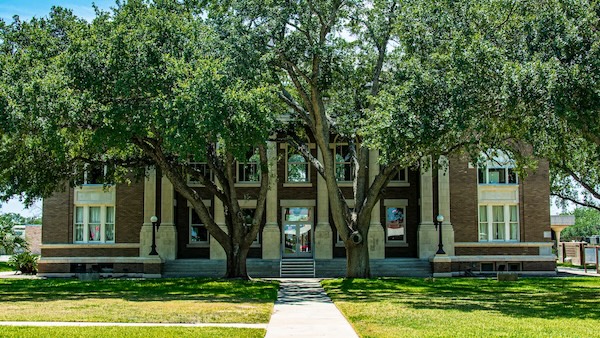
The Brooks County courthouse occupies the middle of the downtown square, facing east through a heavily treed lot. The Courthouse is original, the county having been created in 1911 with courthouse construction following in 1914. The courthouse completed renovation in 2010, restoring much of the original detail.
The architect, Alfred Giles of San Antonio was responsible for 10 other courthouses, six of which still serve the populace. Giles’ Brooks County effort is a particularly good example of the Classic revival style that was replacing the Victorian architecture that characterized much of the earlier Texas courthouses. The renovation accomplished its purpose, and the building presents as stately and serious.
Things To See And Do
The chief draw to the county is the amazing biodiversity. To the extent South Texas was “settled” it was settled across immense ranches, the King Ranch being the best example. One can argue the political, economic, and cultural ramifications of these empires, but one undeniable benefit is that the size of the ranches produced a light human touch on the region’s ecology. The Kleberg Wildlife Research Institute refers to the area that includes Brooks County as “The Last Great Habitat.”
That history has two ramifications. First, there is abundant game, particularly white-tail deer, hog, turkey, quail, and dove. Second, access is limited. You can try your luck obtaining a lease or book a private hunt through La Rucia Ranch or Mariposa Ranch.
As for fishing, there is not a wide variety but Laguna Salada, an approximate 1,300 acre lake is both scenic and a decent place to spend the day angling. Of course, you are within easy driving distance of a host of opportunities on the Texas coast in Kenedy, Hidalgo and Nueces counties.
For traditional sightseeing, the county offers a Heritage Museum. Many catholics make their way to the Don Pedro Jaramillo Shrine and the Sacred Heart Catholic Church. Don Pedro Jaramillo was a celebrated faith healer of the late 1800’s whose fame continues more than a century after his death in 1907.
Texas Ten appreciates that the Old Pioneer Theater has been put to good use as an active bar/saloon, so the traveler can still “wet his whistle” with decent nightlife.
Food, Drinks, And Music (Eat Local!)
There is a fair amount of mix and match in Falfurrias’ restaurants. The emphasis seems to be on comfort food, sometimes with a side of Tex-Mex. Strickland’s Restaurant. Side Door Cafe, and Rebecca’s Breakfast and More fall into that category. Texas Grub Wagon Restaurant and Tino’s Smokehouse seem more focused on classic American while Taqueria Jalisco concentrates on south of the border specialties. Pioneer Saloon has bar food and drinks for late nights and Falfurrias Bakery has great starters fro early mornings.
Where To Drop A Dime (Shop Local!)
You will not spend much time shopping in Falfurrias. Lynn’s Boutique and D’s Boutique should each be worth a quick stop on your way to ro from the beach.
Special Places To Lay Your Head (Stay Local!)
Not really anything of note other than budget hotels.
For The Professional Traveller (Campgrounds and RV Parks)
Special Events
The Brooks County Fair and Livestock Show is late February-early March each year.
Fore! (Golf Courses)
The city of Falfurrias operates a nine-hole municipal course.
Getting To Brooks County
For most of Texas, you drive south, eventually ending up on SH 281 out of San Antonio. Falfurrias is two hours and twenty minutes south of the Alamo. Texas SH 285 runs through Falfurrias on an east to west route. SH 281 runs parallel to the road now designated as I-69, which is actually old SH 77. More broadly, Falfurrias is four hours and 45 minutes of drive time slightly southeast of the geographic center of the state in Brady, Texas. Windshield time from major Texas cities can be seen here.
If you hope to fly in via a major carrier, McAllen International 70 miles to the south is serviced by Allegiant, American, and United; Corpus Christi International 80 miles to the northeast is serviced by American, United, and Southwest; Valley International in Harlingen 90 miles to the south accommodates American, Delta, Southwest, Sun Country, and United; Brownsville Airport 115 miles to the south offers American and United; and San Antonio International 170 miles to the north offers most major carriers. Smaller craft can fly into the Brooks County Airport. If that does not work, there are small municipal airports all within 40 miles at Kleberg County, Alice, Texas, Jim Hogg County, and Nueces County.
History
Historical artifacts reveal a profound narrative of the Couhiltecan people, who inhabited this area a staggering 11,000 years before European settlers. These resilient people, living in small bands with unique dialects, thrived as hunter-gatherers until the Spanish colonial period. They were eventually displaced by Spaniards from Mexico and Apaches from the Northwestern plains. Some found refuge in Spanish missions, while others sought safety in remote areas, their presence fading from history.
Land grants were made by the Spanish and Mexican governments as early as the 1760s, but because the land was challenging to farm and remote, colonists didn’t arrive until the 1800s.
Situated between the Rio Grande and the Nueces River, the area that now makes up Brooks County was a heavily disputed territory between the Texas Revolution and the Mexican War. This forced the original grantees in the region to flee to Mexico.
Not until after the Civil War did most Anglo settlers begin to arrive. Though incoming Anglos assimilated with vaqueros and prominent families in the region, most of the population remained Hispanic until the end of the 19th century.
In 1895, rancher Edward C. Lasater bought the first of many plots in the county and quickly became a prominent figure. At its peak, his Falfurrias ranch reached 350,000 acres and became Texas’s largest cattle breeding ranch. In 1904, the San Antonio and Aransas Pass Railway extended through the ranch, making it the center of trade in the region and the Brooks County seat. Interestingly, it wasn’t until after Falfurrias ranch had become important that Brooks County was named for State Representative James A. Brooks, who had been instrumental in pushing for this area to be separated from Starr County and officially designated as a county in its own right.
With the advent of the railroad, a new era dawned in Brooks County. Land prospectors flocked to the area, bringing settlers and a shift in the economic landscape. The era of large-scale ranching led to the establishment of local farms and ranches. By 1906, the citrus industry was introduced, although its early growth was hampered by frosts and droughts, as were other farming ventures. The 1920s saw the introduction of Jersey cows and the dairy industry, which replaced the fledgling farming industry. Falfurrias butter, renowned for its high-fat content, gained widespread recognition.
Farming continued to suffer during the Great Depression, so the reliance on cattle ranching and related industries increased. In some areas, cotton farming fared better, but it wasn’t until the discovery of oil in 1935 that the economy began to turn around again. Cattle and dairy ranching and oil and gas production were critical throughout the 1990s.
Due to its warm climate, the demographics have changed in recent years to reflect a growing population of retirees and Mexican Americans. Politically, this area has remained staunchly Democratic in local, state, and national elections.
According to the 2020 census, Brooks County’s population is 7,076, with a median income of $30,566. 19.1% of the population have a bachelor’s degree or higher. 88.4% of the population in Brooks County are Hispanic or Latino, 4.12% are white, 4% are black, or 2 or more races.
Primary Sources: